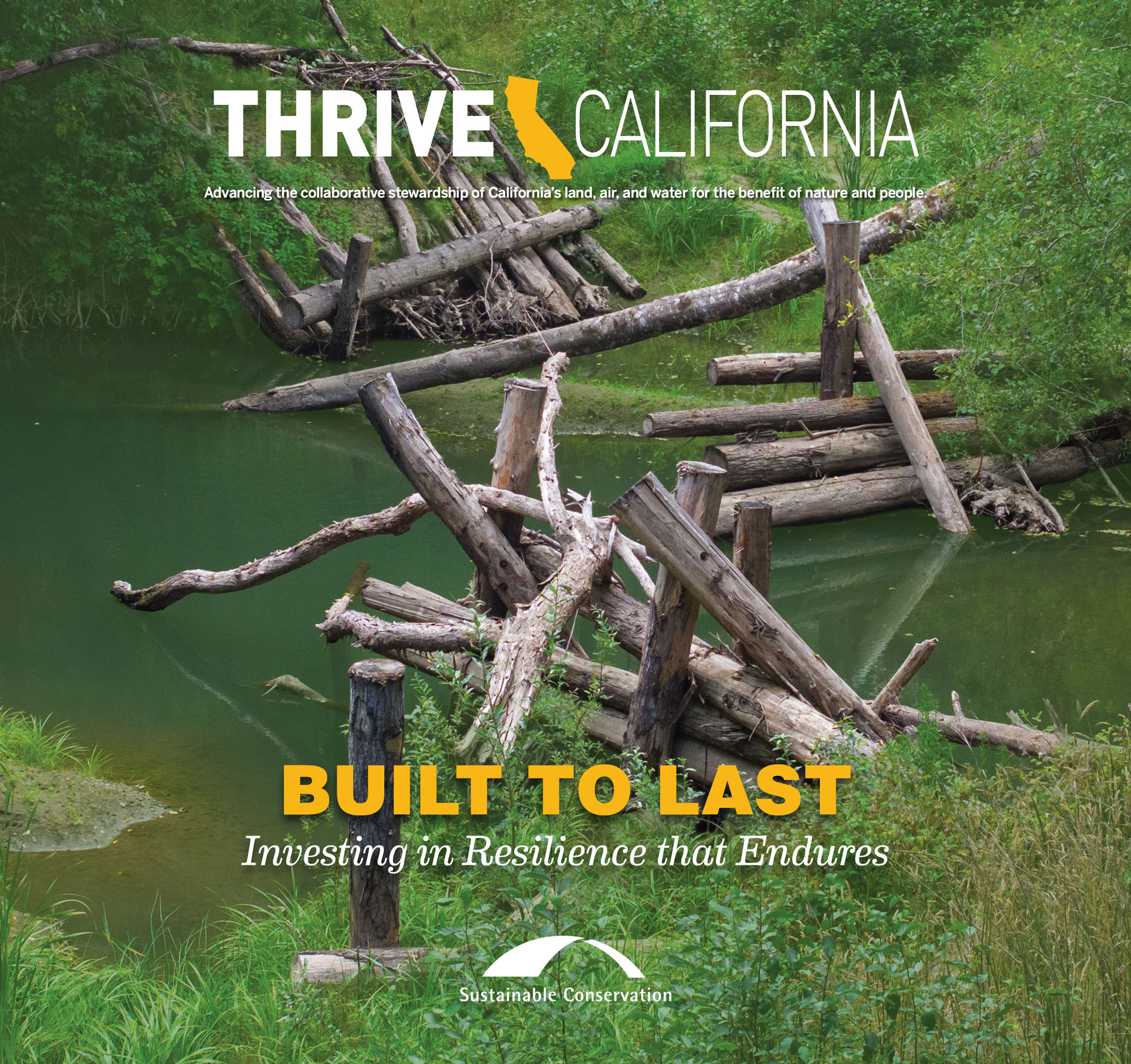
Pictured: Restoration done by The Nature Conservancy on Mendocino coast’s Ten Mile River. These “log jams” are engineered structures designed to replicate the natural accumulation of large fallen trees that provide high quality habitat for salmon and other aquatic species.
More than two decades ago, Sustainable Conservation recognized that permitting was an unnecessarily burdensome obstacle to restoring California’s habitats and waterways. Dedicated restoration advocates with shovel-ready projects were spending years and tens of thousands of dollars navigating complex and sometimes duplicative regulatory processes before any work could be done. Meanwhile, our rivers, wetlands, and their ecosystems were left degraded and fragmented. But today, ecologically beneficial restoration projects across California are moving forward at a greater pace and scale thanks to the work of Sustainable Conservation and our partners.
The team saw that designing permitting pathways specifically for restoration could reduce time and cost while maintaining strong environmental protections. So, we got to work with dozens of partners across agencies and organizations who shared a similar goal. As more restoration-specific permits came online, they moved into the mainstream as standard pathways for restoration projects.
That progress is now being institutionalized at the highest levels of state and agency leadership. The best example of this is the California Natural Resources Agency’s Cutting Green Tape program. Through this initiative, an improved review process at the Department of Fish and Wildlife has helped restore over 300,000 acres of habitat, reconnect 5.5 million acres of land, and improve 700 miles of streams in four years — with $12.5 million in estimated savings that can go towards new projects.
Alongside efforts to expand restoration-specific pathways, we are closing the implementation gap by helping practitioners use existing tools and advising agencies on how successful models like Cutting Green Tape can be applied more broadly.
After years of steady progress and early wins, we’re now seeing the compounding effects of long-term investment take hold. If we’ve learned anything from the history of the Accelerating Restoration program, it’s that what we accomplish together this year will secure the gains for natural landscapes for every year that follows.
With gratitude,

Josette Lewis
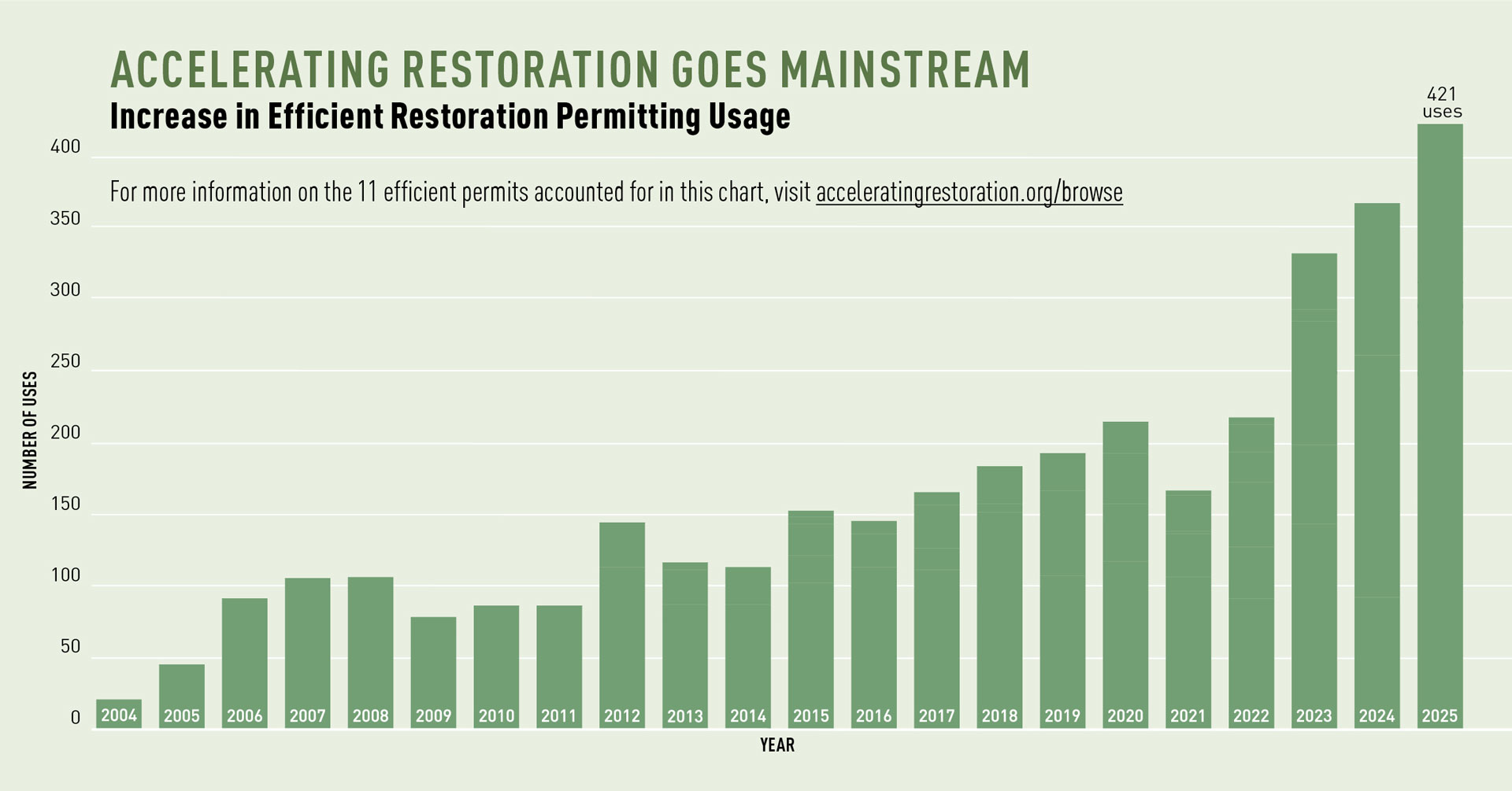
Expedited permits now enable restoration at a pace and scale previously limited by regulatory and procedural burdens, while ensuring environmental protections are maintained. Projects that once stalled for years are now moving forward in months, allowing funding, partnerships, and momentum to translate directly into beneficial restoration.
NOAA’s Restoration Center calculated that their restoration-specific permits that cover protections for endangered species have saved an estimated $10.6-$27.2 million in staff time and consultant fees since 2006. For regulators, these pathways lower paperwork burdens while providing clarity, consistency, and strong environmental safeguards; for restoration practitioners, they offer predictability and speed.
Every hour saved in permitting is an hour gained for implementation, and every dollar saved is a dollar that can be spent on improving the functionality and resilience of California’s natural landscapes.
Work from Peter and other restorationists has helped drive a remarkable rebound: more than 30,000 endangered Central Coast coho salmon returned to Mendocino Coast rivers in 2024-2025, double the previous record and up from just about 3,000 annually a decade ago.
Previously, when we were doing stream restoration, we were limited to small habitat restoration permitting pathways. Now that we’re free from those constraints, we actually have the potential to make a real difference. We can usually take a large project from concept to construction in about a year and a half, whereas previously that would have taken us five years.
Peter van de Burgt
Pictured: McCormack-Williamson Tract Levee Modification and Habitat Restoration Project in Sacramento County, which used the State Water Board Statewide Restoration General Order restoration permit, among others. Multiple benefits of the project include flood risk reduction and expansion of marsh and floodplain habit. Credit: CA DWR
There are many conservation issues where permitting can be a disproportionate burden. Why, then, has Sustainable Conservation focused its effort on restoration?
Because restoration is one of the highest-leverage ways to address multiple natural resource challenges at once. When rivers, wetlands, and working lands function as they should, they preserve biodiversity, reduce flood risk, improve water quality, recharge groundwater, and sustain communities and agriculture.
Restored floodplains and streambanks slow water down and allow it to safely spread out after storms. Excess water has time to sink into aquifers rather than hurtle downstream and flood communities. At the same time, these floodplains create high-quality habitat for migratory birds and aquatic species like salmon to feed and spawn.
The recent Department of Water Resources’ Watershed Studies illustrate that climate change is reshaping when and how precipitation falls in California, with more intense rainfall events and less snowpack to sustain rivers through dry months. This shift places new pressure on groundwater systems and the communities and ecosystems that depend on them. However, increasing the connectivity and resilience of California’s watersheds through restoration can simultaneously address water resource challenges such as groundwater overdraft, river degradation, or community flood risk at their sources.
In short, there is no water security without landscape-scale restoration.
The resilience California needs against floods, drought, and groundwater depletion lives in the health and connectivity of its landscapes. California can’t engineer its way out of its changing water reality.
A single restored stream is great. But a restored watershed with revitalized waterways, floodplains, and biodiverse habitats is orders of magnitude more powerful. With lower overhead costs and more expedited pathways available for restoration project proponents, Californians can realize the full spectrum of benefits that connected, landscape-scale restoration presents to their ecosystems, farms, and water resources.
Achieving this vision is what will yield the maximum return on investment made by Sustainable Conservation, its supporters, and its partners in improving the speed, scale, and safety of ecological restoration across all of California’s geographies.

When you think about the stacked benefits — groundwater recharge, improved water quality, flood safety, wildlife recovery, parks, recreational opportunities, and carbon sequestration — investing in floodplain restoration is the best thing for the long-term health of Central Valley communities and the best way to spend public dollars.
Julie Rentner
California’s restoration story is written in thousands of quiet moments: a small dam removed, a permit approved in weeks instead of years, a stretch of streambank replanted and dechannelized. Connect enough of those moments, and you have a restored, resilient California.
Sustainable Conservation fills the gaps that naturally occur when the regulatory process traverses organizations, permits, and geographies. Leadership is paying attention. In February 2026, CNRA Secretary Wade Crowfoot and CalEPA Secretary Yana Garcia jointly directed all state departments to permanently embed Cutting Green Tape practices into standard procedure, providing another proof point for what has become the mainstream support for restoration permitting reform. As Secretary Crowfoot has recognized, Sustainable Conservation brings the creative problem-solving capacity that agencies need but are not necessarily designed for.
Given all the historic conflict on water — fish versus farms, north versus south, urban versus rural — Sustainable Conservation has been a trusted partner across all of those differences and ultimately a bridge.
CNRA Secretary Wade Crowfoot
With a strong foundation and an aligned coalition of partners, the progress the Accelerating Restoration program has made with your support to increase the pace and scale of habitat restoration is undoubtedly built to last. And the most exciting chapters are still ahead.