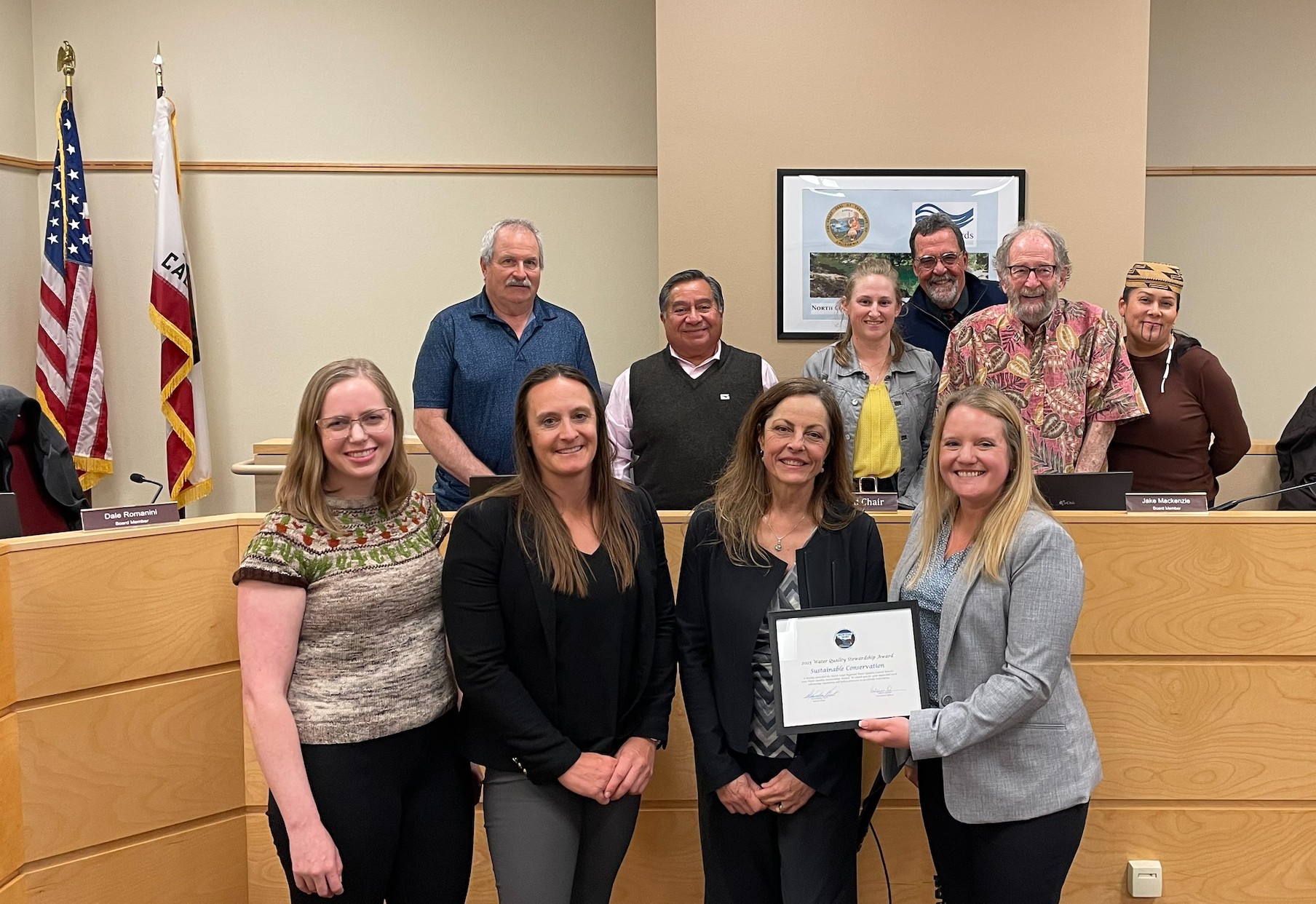
Sustainable Conservation’s Accelerating Restoration team receiving the North Coast Regional Water Quality Control Board Executive Officer’s 2025 Water Quality Stewardship Award
Sustainable Conservation’s Accelerating Restoration Team Receives Water Quality Stewardship Award
At the North Coast Regional Water Quality Control Board’s April 15th meeting, Sustainable Conservation’s Accelerating Restoration team was honored with the Executive Officer’s 2025 Water Quality Stewardship Award. The annual award recognizes partners whose work directly contributes to the preservation and enhancement of surface and groundwater quality across the North Coast Region. This year’s award recognized the decades of work the team has put into restoration permitting improvements to make habitat restoration faster, more effective, and more accessible across California.
For more than two decades, Sustainable Conservation’s Accelerating Restoration program has played a transformative role in advancing habitat restoration by championing regulatory and policy innovations that increase both the pace and scale of restoration projects. Through a highly collaborative approach with agencies and restoration practitioners, they have successfully built bridges across institutions to find practical solutions that support environmental recovery.
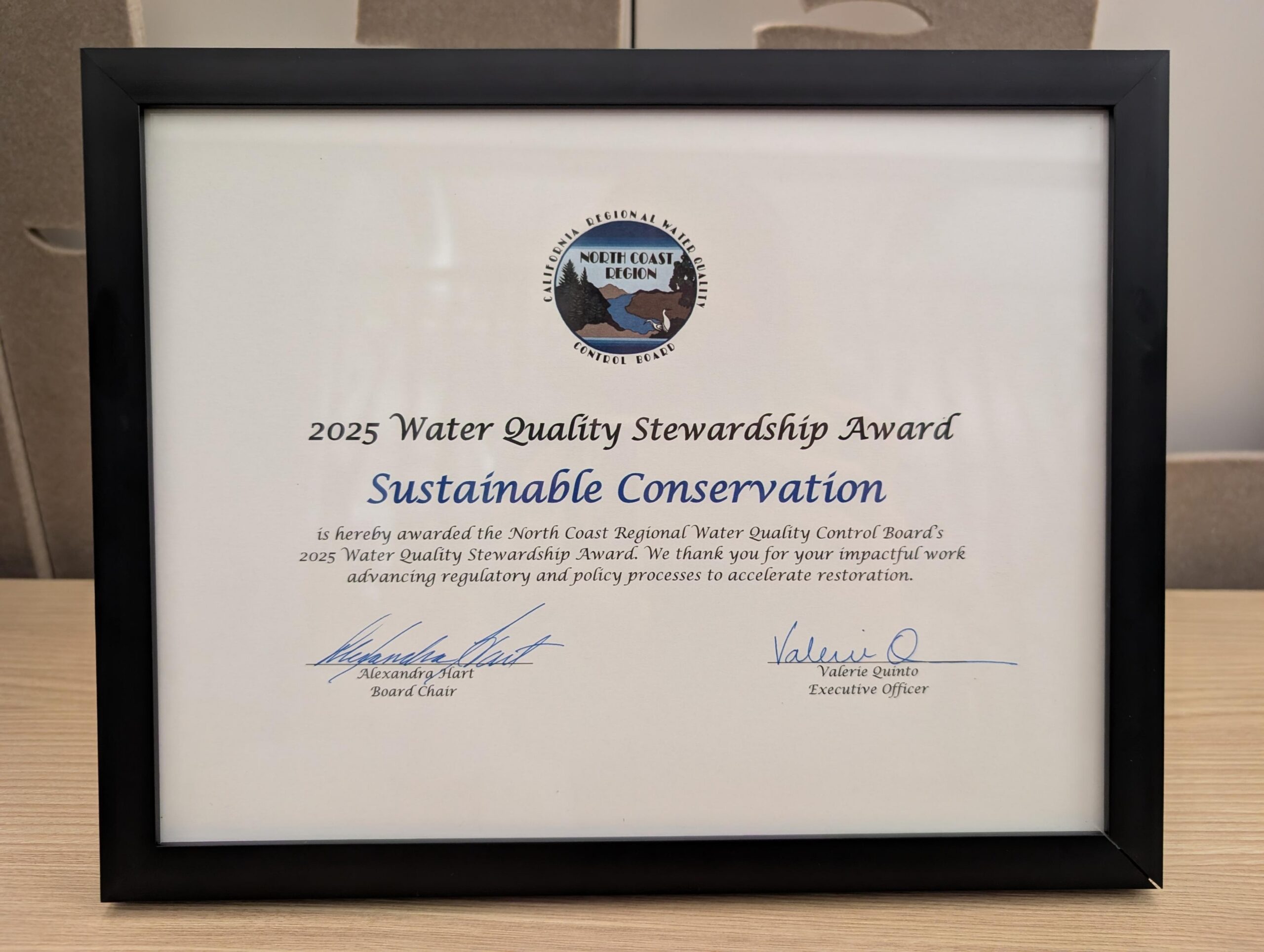
North Coast Regional Water Quality Control Board Executive Officer’s 2025 Water Quality Stewardship Award
The team is especially grateful to Valerie Quinto, North Coast Water Board Executive Officer, and Jake Shannon, North Coast Water Board restoration coordination specialist, for the nomination and for the years of partnership they have enjoyed with the Regional Water Board. From Sustainable Conservation’s perspective, Valerie and the North Coast Water Board team deserve recognition in their own right for the leadership they have provided to agencies and restoration partners. Their willingness to collaborate, problem-solve, and advance permitting tools like the Statewide Restoration General Order is foundational to scaling restoration and water quality improvement across the region and the state.
Water Quality Improvement and Protection through Habitat Restoration
The State and Regional Water Boards, collectively known as the Water Boards, largely oversee pollutant discharges and activities in and around waterbodies. As such, they also play a part in regulating ecological restoration projects in an aquatic environment, as these projects often involve short-term impacts like ground disturbance in order to realize the long-term benefits to water quality.
Ecological restoration can support the Water Board’s goals to enhance water quality, prevent pollution, and restore beneficial uses for wildlife and people. For example, healthy, connected floodplains and wetlands slow and spread water, reducing flood risk and replenishing groundwater supplies. Restored stream channels reduce erosion and excess sediment, which is one of the most common impairments to water quality in California waterways.
Just as important, well-designed restoration projects prevent future degradation of water quality and habitat. Stabilizing landscapes and improving filtration by maintaining natural processes keeps waterways clean and thriving. By making it faster and simpler to implement restoration projects, these benefits can be realized sooner and at a lower cost.
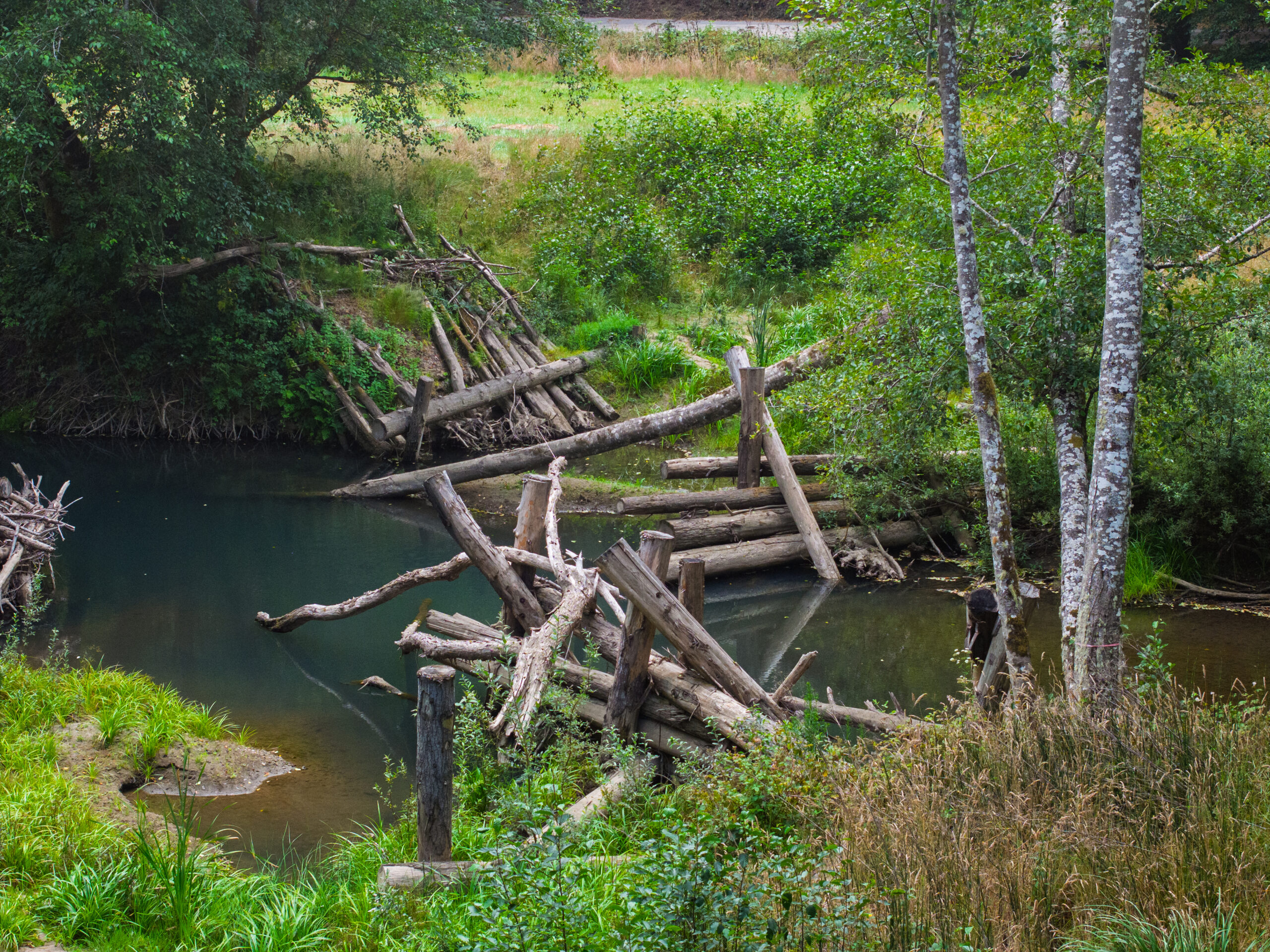
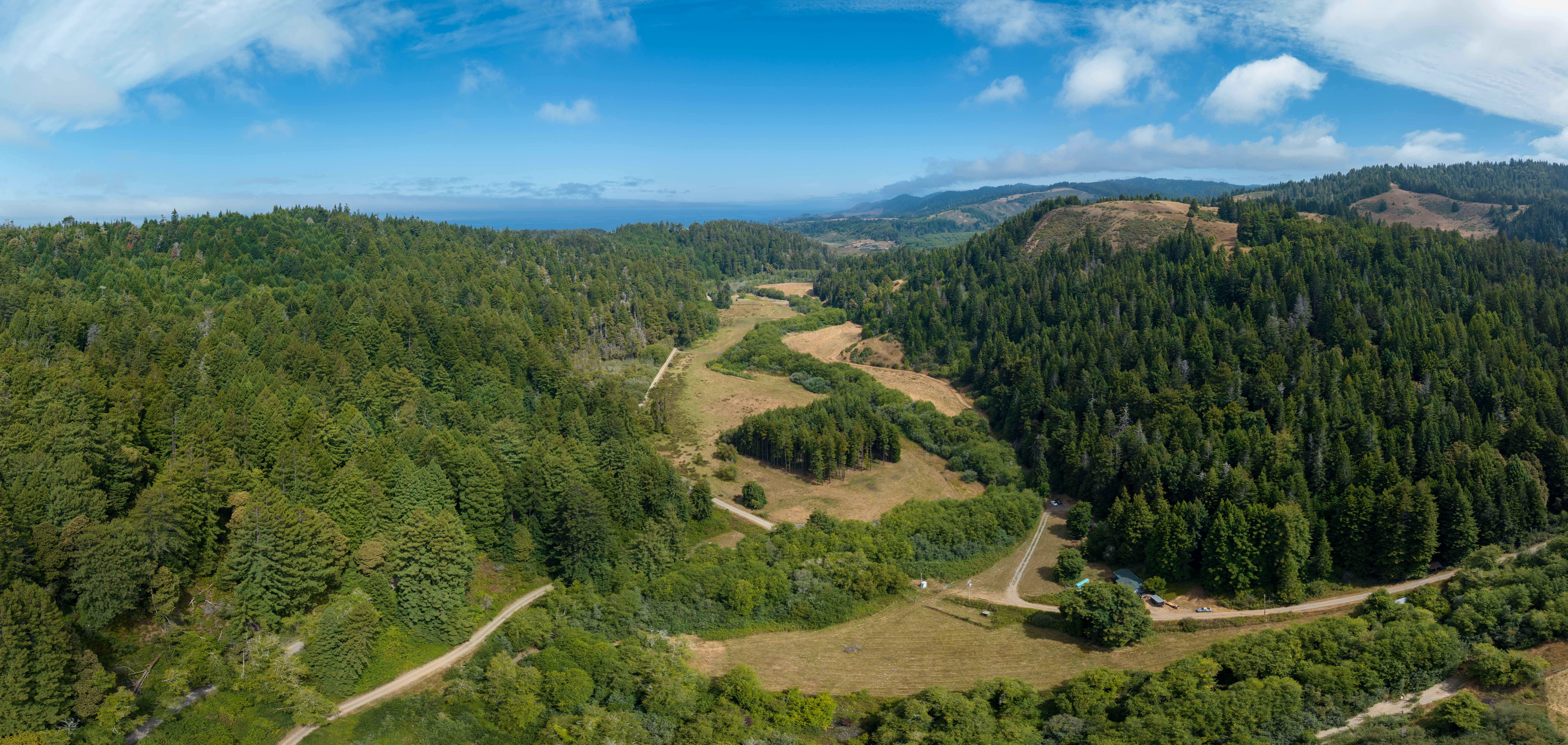
Photos of Mendocino County’s Ten Mile River, where The Nature Conservancy (TNC) has been leading habitat restoration efforts for over a decade. The project used two new permitting pathways that were developed through Sustainable Conservation’s Statewide Restoration Permitting Initiative with the State Water Board and U.S. Fish and Wildlife Service.
Historically, however, the lack of efficient permitting tools for large scale projects available to the Water Boards and other agencies stymied progress towards water quality improvement and restoration project implementation. Regulatory improvements for restoration at the Water Boards started with their creation of a Small Habitat Restoration Permit. This process laid the foundation for the Sustainable Conservation-sponsored Habitat Restoration and Enhancement Act (HREA), which developed a new collaborative approach for the California Department of Fish and Wildlife, the Water Boards, and restoration practitioners to work together and support environmental recovery.
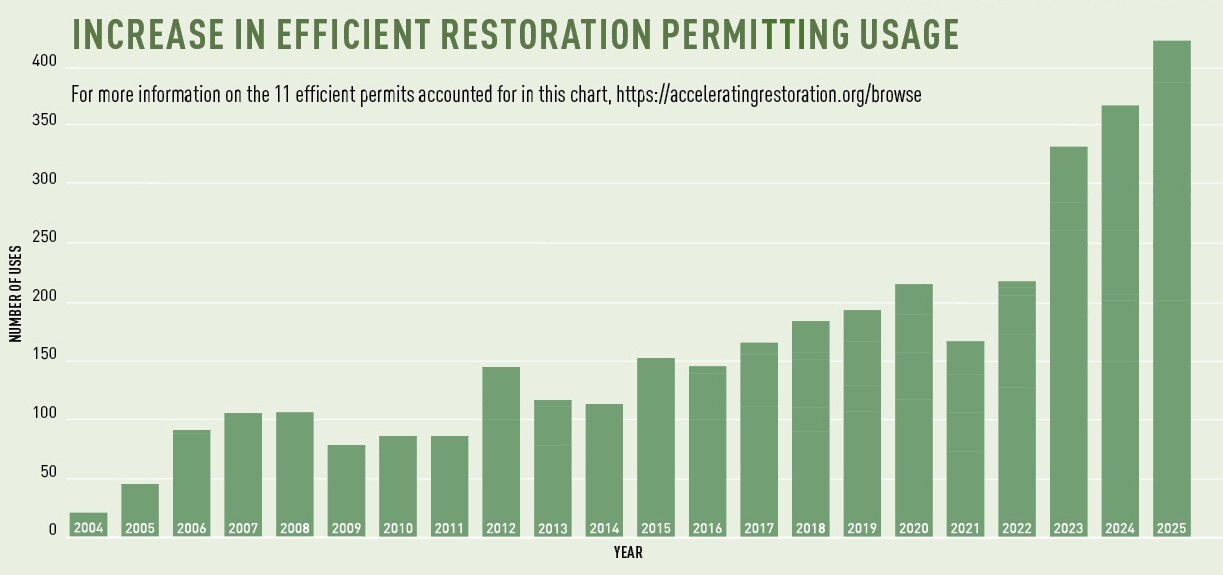
The restoration permitting toolbox has only grown since the HREA, with tools now in place to expedite permitting for larger projects, further enabling the Water Board and other agencies to better regulate and support large-scale restoration. With more of these tools (see chart below), restoration practitioners are increasing the connectivity and resilience of California’s watersheds with restoration that simultaneously addresses water resource challenges at their sources.
Building a Better Path for Restoration
Over 20 years ago, Sustainable Conservation saw that permitting pathways designed specifically for restoration could reduce the time and cost associated with planning and implementing projects, while keeping strong environmental protections in place. With a restoration project needing approval from numerous agencies before project implementation can begin, it’s important for each agency to have their own restoration-specific permitting pathway that can serve as a guide for project planning and efficient approval.
The organization began to work with dozens of agencies and applicants who shared a similar goal. As more restoration-specific permits came online, their overall usage increased, and they became a model for other agencies to develop new processes.
Among their many achievements, Sustainable Conservation has helped develop several statewide programmatic permits with the State Water Board, the California Department of Fish and Wildlife, National Oceanic and Atmospheric Administration, the U.S. Fish and Wildlife Service, and the California Coastal Commission. These forward-thinking permits streamline approvals for common restoration activities while ensuring strong environmental protections.
North Coast Regional Water Quality Control Board Executive Officer’s 2025 Water Quality Stewardship Award
Recent data from the State Water Resources Control Board’s Ebb & Flow blog shows that the Statewide Restoration General Order (SRGO), one key expedited permitting tool Sustainable Conservation helped develop, saved projects an average of $25,730 and reduced processing time nearly six months per project in 2025. There were 56 SRGO approvals last year according to Sustainable Conservation data, accounting for $1.44 million in cost savings for restorationists. What does this mean for the state’s waterways and imperiled species? Project benefits are realized sooner, and over a longer period of time. Saving time and money on administrative tasks leaves more funds for additional or larger restoration projects, resulting in state bonds and grants going further than ever before.
This award is a testament to the investment of time and resources made by restoration project proponents, agencies, nonprofits, and other outstanding partners in co-creating new permitting pathways for habitat restoration. As a result, California is now seeing an increase in the pace and scale of environmental restoration across its geographies.
The Accelerating Restoration team will continue to renew and improve restoration-specific permits, support agencies in developing coordinated pathways, and provide technical assistance on how best to take advantage of those pathways — ensuring that restoration projects can move forward at the speed needed to protect and improve California’s water quality and ecosystems.
