
- Climate change drops US GDP by an estimated 3% as global temperatures tick upward.
Read full summary ▾
- US households pay up to $1,000 every year in climate-related costs like spiked insurance premiums and utility bills.
- Wildfires destroy billions in property annually, causing major insurance companies to pull out of high-risk states entirely.
- California grows half of the country’s fruits, nuts, and vegetables, meaning local weather disasters trigger nationwide grocery price hikes.
- Overdrafted groundwater basins force water districts to spend heavily on massive infrastructure repairs and artificial recharge projects.
This article discusses the financial strain hitting American businesses and families. You will see the exact strategies California farmers and water managers use to protect their soil, capture floodwaters, and keep food production stable.
The financial costs of climate change are showing up in grocery prices, water bills, insurance markets, and disaster recovery budgets. For many households and businesses, the pressure is already measurable.
At Sustainable Conservation, we look at these challenges practically. Protecting California’s land and water is what keeps water supplies reliable and communities economically stable. The notion that environmental protection comes at the expense of business feasibility is outdated, and that economic resilience is inherently linked to natural resource conservation.
This article discusses what that looks like in economic terms, starting with the national macroeconomic insight, then narrowing into California’s specific agricultural and water challenges. We’ll also discuss collaborative, science-backed solutions that are already protecting both working land and the bottom line.
What is climate change?
Climate change refers to long-term shifts in global temperatures and weather patterns. Since the mid-20th century, these changes have been caused primarily by human activities, particularly the burning of fossil fuels, which increases heat-trapping greenhouse gases in the atmosphere and raises Earth’s average surface temperature.
Average global temperatures have already increased about 2°F since 1850, and the effects are showing up across water systems, agriculture, and coastlines. According to NASA, Earth is warming at an unprecedented rate, and the effects will worsen as long as humans continue adding greenhouse gases to the atmosphere.
How does climate change impact the economy?
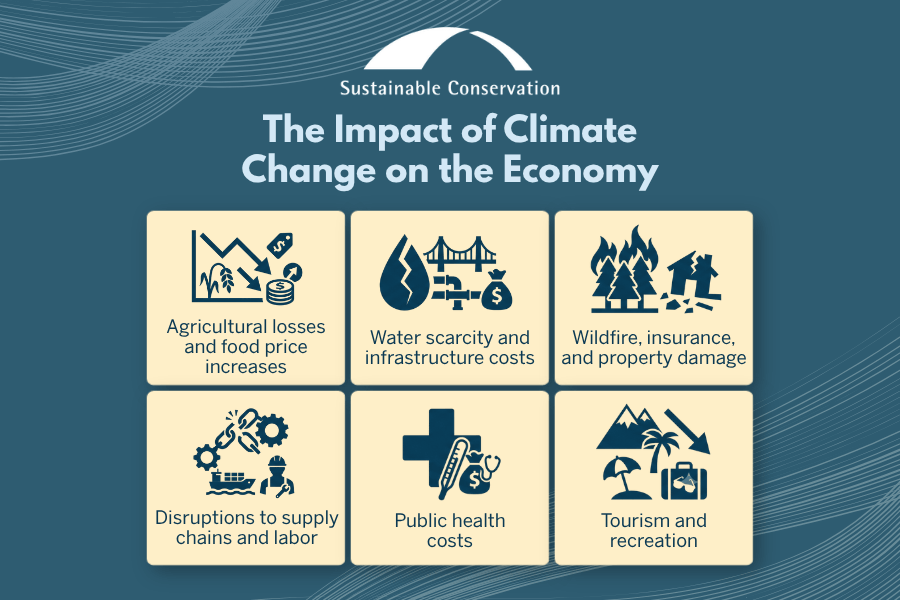
Climate change is commonly known as an environmental issue, but its effects go beyond that. In fact, it creates financial pressure across industries, and the costs keep growing year by year.
These are the main areas where it’s hitting the US economy hardest:
Agricultural losses and food price increases
Farming depends on predictable weather, and that predictability is disappearing for many growers across the country. Droughts, heat waves, floods, and shifting seasons are cutting into crop yields and pushing up the cost of irrigation, pest control, and replanting. When production costs rise, or harvests come up short, grocery prices follow.
For example, California grows nearly half of the country’s vegetables and over three-quarters of its fruits and nuts. This means that what happens to California’s weather doesn’t stay in California. Instead, it shows up in grocery stores and food supply chains nationwide.
Water scarcity and infrastructure costs
Both farms and cities depend on reliable, clean water, and that supply is under serious strain. Shrinking snowpack in the Sierra Nevada means less water is stored naturally for spring and summer, and snowpack provides about a third of the state’s total water supply in normal years. To make up for it, communities and farms lean harder on groundwater, which is already being pumped faster than it can refill. As a result, water tables drop, and pumping costs go up.
Managing that scarcity is expensive. Water agencies and agricultural districts are investing billions in new infrastructure and desalination projects, both of which carry significant costs. And because storms are getting more intense, flooding causes its own wave of repair and reinforcement costs.
Wildfire, insurance, and property damage
Longer, hotter dry seasons have made wildfires a recurring economic disaster across the American West. The 2025 Los Angeles fires alone caused total property and capital losses estimated between $95 billion and $164 billion. The costs don’t stop at the burn zone. Emergency response drains state and federal budgets every year. Smoke travels hundreds of miles, keeping people indoors, cutting into productivity, forcing business closures, and driving up hospital admissions from respiratory illness.
The insurance market has responded by pulling back. From 2021 to 2024, homeowner insurance premiums rose an average of 24% nationwide, and major insurers have either left high-risk states entirely or raised premiums by as much as 50 percent, leaving many homeowners without viable coverage. When insurance disappears, property values tend to follow. Falling values shrink the local tax base, cutting funding for schools, roads, and emergency services.
Disruptions to supply chains and labor
Extreme heat hits outdoor workers first. In agriculture, construction, and landscaping, dangerous temperatures force shorter working hours, slow down projects, and raise costs for managing heat illness and workplace safety. According to research cited in OSHA testimony, extreme heat costs the US economy an estimated $100 billion per year in lost productivity, with losses potentially doubling to $200 billion by 2030 without meaningful action.
Severe weather also disrupts how goods move. Flooding, storms, and damaged roads shut down trucking routes, rail lines, and port facilities. When those transportation corridors go down, supply chains stall. Businesses end up dealing with parts shortages and inventory delays, and the costs ripple outward from there.
Public health costs
Climate change is showing up in healthcare budgets in several ways. More frequent heat waves mean more heat-related illnesses, which puts pressure on emergency rooms and hospital systems. Wildfire smoke and ozone pollution worsen respiratory conditions like asthma, leading to more doctor visits, missed school days, and lost work time.
Warmer temperatures are also expanding the range of disease-carrying insects. Mosquitoes and ticks are showing up in places they didn’t reach before, bringing health risks to new populations. And beyond the physical toll, communities hit repeatedly by disasters are dealing with growing mental health burdens, which add their own long-term costs to an already strained healthcare system.
Tourism and recreation
Outdoor recreation drives the economy in thousands of rural communities, and climate change is putting that at risk. Ski resorts are dealing with shorter seasons and unreliable snowfall, which forces costly investments in artificial snowmaking or leads to early closures. National parks and coastal destinations face erosion, trail damage, and sudden shutdowns during wildfire season, and limited access and public perceptions of danger translate directly into lost visitor revenue for the businesses that depend on them.
When people can’t access or don’t want to visit these places, the impact is immediate for local hotels, restaurants, guide services, and shops. For communities that depend almost entirely on tourism, it’s a threat to their economic survival.
How is the US addressing climate change?
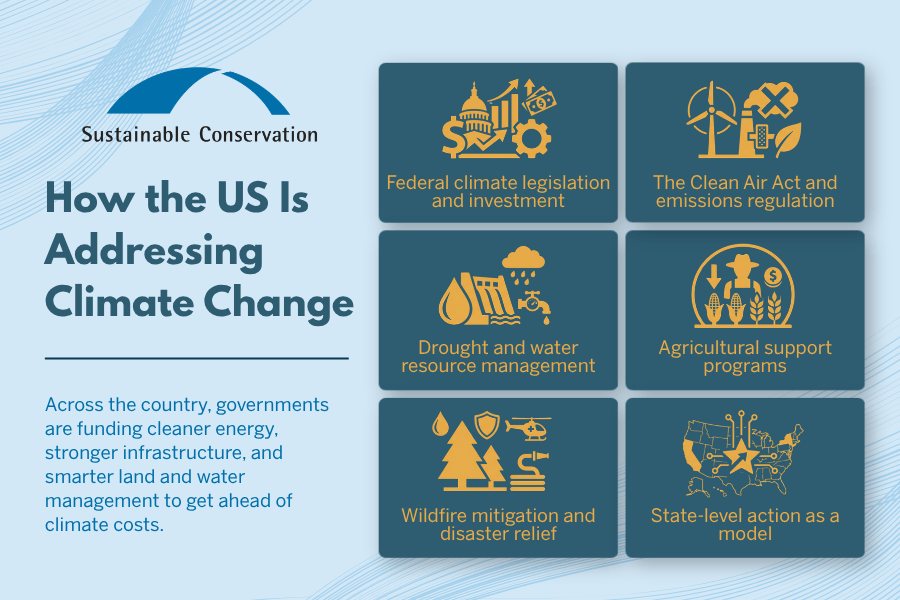
Federal and state governments have taken steps to cut emissions, strengthen infrastructure, and help communities adapt. Progress has been uneven, and it shifts with each administration, but several significant efforts are currently in place.
Federal climate legislation and investment
In recent years, federal legislative packages have directed billions of dollars toward clean energy, grid upgrades, and climate resilience. The goals include helping cities and towns harden their water systems and infrastructure before disasters hit, lowering the cost of clean technology over time, and reducing the far larger price tag that comes with post-disaster recovery. The Infrastructure Investment and Jobs Act and the Inflation Reduction Act together directed over $40 billion to the EPA alone for water infrastructure, greenhouse gas reduction, and climate resilience programs.
That said, funding availability and program priorities are shifting in 2026 as federal policy continues to change. It’s worth checking EPA’s climate change resources for the latest on what’s currently funded and available.
The Clean Air Act and emissions regulation
The EPA has authority under the Clean Air Act to set limits on greenhouse gas emissions from vehicles, power plants, and heavy industry. These standards give federal regulators a direct way to reduce the total volume of emissions driving global temperature increases.
The regulatory picture is in flux. Rules are frequently challenged in court or revised by new administrations. But the Clean Air Act framework remains one of the main levers the federal government has for holding industries accountable for their emissions.
Drought and water resource management
The Bureau of Reclamation and the USDA run programs specifically focused on water efficiency and drought planning across the West. They work with states to coordinate water deliveries from shared river systems and help local agencies develop groundwater management plans.
Federal funding through these programs helps agricultural districts upgrade aging canals that lose significant water to seepage and evaporation. Technical support is also available to help local water managers forecast seasonal supplies as mountain snowpack continues to shrink.
Agricultural support programs
The USDA runs two major conservation programs that fund farmers directly to adopt climate-smart practices. The Environmental Quality Incentives Program (EQIP) and the Conservation Stewardship Program (CSP) provide financial and technical assistance to producers who reduce emissions, build soil organic matter, and use water more efficiently.
These national programs connect directly to state-level efforts like California’s Healthy Soils Program and the State Water Efficiency & Enhancement Program (SWEEP). When federal and state incentives are stacked together, farmers have a much more realistic path to covering the upfront costs of changing how they manage their land.
Wildfire mitigation and disaster relief
Federal agencies put funding each year into forest management, hazardous fuel reduction, and prescribed burns to reduce how severe wildfires get. When fires do break out, federal resources cover emergency response and help communities rebuild afterward.
The Federal Emergency Management Agency (FEMA) coordinates recovery efforts, including housing and infrastructure repairs. In addition, the National Flood Insurance Program covers properties in high-risk flood zones, though it’s under ongoing pressure to update its pricing to reflect how much flood risk has grown in recent years.
State-level action as a model
When federal climate leadership slows down or changes direction, states often move forward on their own. California has become one of the clearest examples of what independent state-level action can look like.
A few of the major initiatives driving that:
- Cap-and-trade program: California sets a cap on greenhouse gas emissions and lets companies buy and sell permits within that limit. That creates a direct financial incentive for businesses to cut their pollution rather than just pay for the right to emit it.
- Sustainable Groundwater Management Act (SGMA): This law requires local water agencies to develop long-term plans to bring overdrafted groundwater basins back into balance. It’s designed to prevent the permanent loss of aquifers that farms and communities depend on.
- 30×30 conservation goals: California has set a formal target to conserve 30% of its land and coastal waters by 2030, with the goal of protecting biodiversity and keeping natural carbon sinks intact.
What is Sustainable Conservation doing in California to combat climate change?
Sustainable Conservation works directly at the intersection of California’s biggest climate-related challenges: water, soil, waste, and habitat. Rather than focusing on advocacy alone, we build practical, on-the-ground solutions alongside farmers, water agencies, and local communities.
Replenishing groundwater supplies: Water for the Future
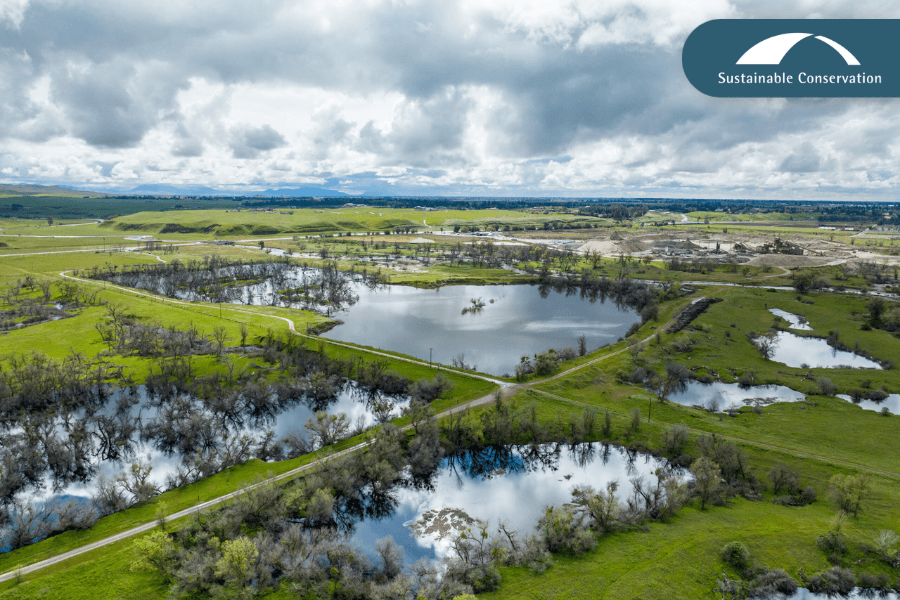
We work with growers and water managers across the Central Valley to put on-farm groundwater recharge into practice. During wet seasons, when rivers run high and rain is plentiful, we help direct that excess water onto agricultural fields and fallow land so it can sink down and refill underground aquifers. We also build watershed modeling tools that help managers figure out exactly where and when to move water to make recharge safer and more effective.
This work gives farming communities a concrete way to meet their SGMA obligations and keep local water supplies stable when drought hits.
Building healthier soils: Solutions in Our Soil
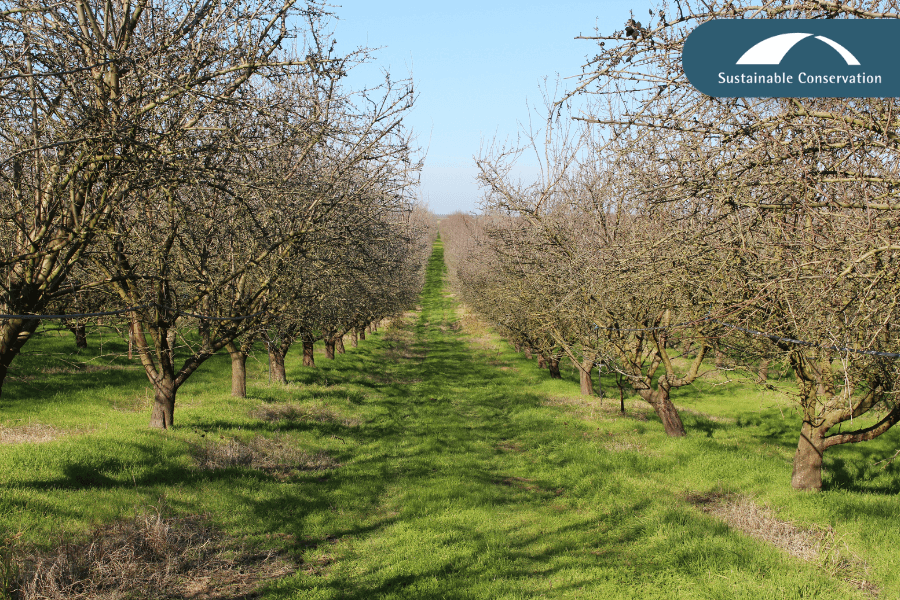
Aside from growing crops, healthy soil holds water, reduces runoff, and helps farms stay productive through dry spells. We help farmers understand how management choices affect what’s happening underground and how practices like cover cropping and reduced tillage can improve both water retention and long-term soil structure.
Those same practices also pull carbon out of the atmosphere and store it in the ground, which contributes to California’s broader emissions reduction goals.
Reducing agricultural waste and pollution: Waste Not

In California dairies, we’re helping farms turn waste into a resource. One of the main tools we piloted and now promote is Manure Subsurface Drip Irrigation, a system that delivers liquid dairy manure directly to crop roots below the soil surface. It replaces synthetic fertilizers with an organic, on-farm alternative, reduces nitrate leaching into local drinking water, and cuts greenhouse gas emissions at the same time.
Restoring rivers and habitat: Accelerating Restoration
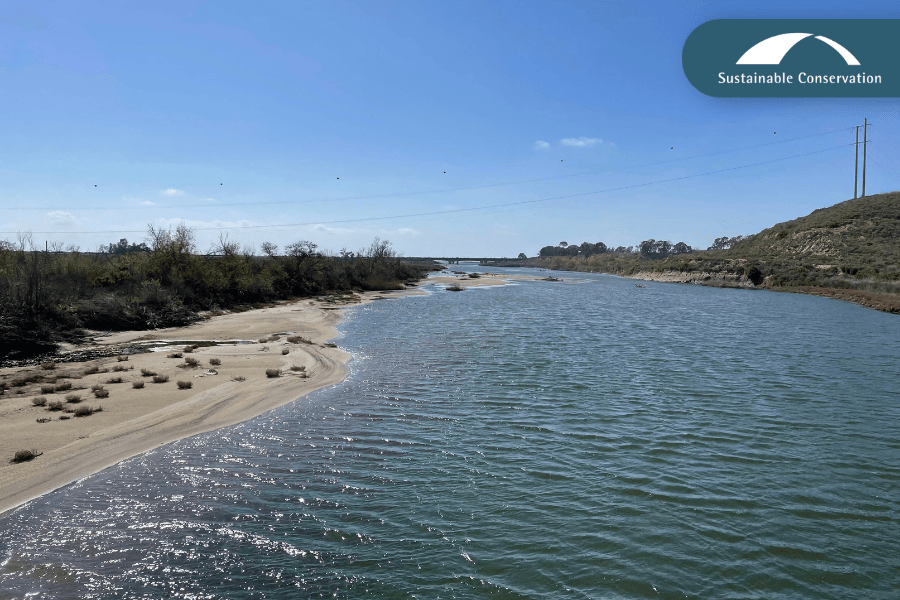
California’s rivers and streams are under pressure from rising temperatures, and restoration projects often sit stalled in lengthy permitting processes. We work with state and federal agencies to clear those regulatory bottlenecks and create faster pathways for projects that are clearly good for the environment.
When restoration moves faster and costs less, more of it gets done. Restored streams and floodplains give native fish cooler water to survive in and improve water quality for nearby communities.
Frequently Asked Questions (FAQs)
Climate change raises costs across nearly every sector, including higher food prices due to crop losses, increased spending on water infrastructure, disaster recovery, and healthcare. US households are already paying as much as $1,000 per year in climate-related costs in some regions, including energy bills, insurance premiums, and health risks from extreme weather.
The biggest risks are disruptions to agriculture and food supply, instability in insurance and real estate markets, reduced labor productivity from extreme heat, and the long-term cost of rebuilding after floods, wildfires, and storms. The Congressional Budget Office estimates that US GDP could be 3% lower than it would otherwise be as temperatures rise.
It widens inequality. Lower-income communities tend to bear a higher share of the costs through lost wages, health burdens, and displacement after disasters, while having fewer resources to adapt or recover.
Developing countries tend to get hit hardest by climate change despite contributing the least to the problem. According to the World Bank, the 74 lowest-income countries produce just one-tenth of global greenhouse gas emissions, yet face the greatest consequences. In fact, climate change has widened the wealth gap between rich and poor nations by 25% since 1960, and extreme weather alone is already pushing 26 million people into poverty every year.
The most proven approaches include reducing greenhouse gas emissions through clean energy and industrial reform, adopting sustainable agricultural practices like cover cropping and groundwater recharge, restoring natural habitats that absorb carbon, and implementing strong water management policies. In California, Sustainable Conservation works directly with farmers and water agencies to put these solutions into practice.