Sustainable Conservation is proud to announce the new report: “Accelerating Restoration in the Sacramento-San Joaquin Delta and the Suisun Marsh: Progress and Next Steps to Cut Green Tape”
Authors: Katie Haldeman, Stephanie Falzone, Erika Lovejoy, Shayan Kaveh, and Hayley Willner
In collaboration with The Nature Conservancy
Press release New Report Identifies Pathways to Accelerate Restoration in the Delta and Suisun Marsh
San Francisco, CA — September 28, 2026 — Today, Sustainable Conservation released a new white paper, “Accelerating Restoration in the Sacramento-San Joaquin Delta and the Suisun Marsh: Progress and Next Steps to Cut Green Tape,” examining how California can build on recent progress and remove remaining barriers to restoration in one of the state’s most ecologically and economically important landscapes.
Developed in collaboration with The Nature Conservancy and informed by surveys and interviews with 27 organizations involved in Delta restoration, the white paper provides several recommendations to address the largest challenges to timely, landscape-scale restoration in the Delta and Suisun Marsh. The white paper also examines how well the state’s restoration-specific permitting tools are working in the Delta, where gaps remain, and what is needed to meet California’s climate and habitat goals on time.
“The Sacramento-San Joaquin Delta and the Suisun Marsh are two of our state’s most important ecosystems, providing outsized conservation, economic, and recreational value to millions of Californians,” said Sydney Chamberlin, Project Director at The Nature Conservancy in California. “Protecting these iconic landscapes is paramount to achieving California’s climate goals and bolstering our state’s resilience to climate change. This white paper is a critical roadmap for building on existing conservation efforts and accelerating future restoration across the entire region.”
The Challenges and Potential of Delta Restoration
Spanning 738,000 acres and home to more than 600,000 people, the Sacramento-San Joaquin Delta contributes to the water supply for more than 27 million Californians and is integral to California’s $50 billion agricultural industry. However, the Delta has lost nearly 95% of its historic wetland habitat. Drained wetlands in the Delta release up to 1.2 million metric tons of carbon dioxide each year, and the resulting subsidence threatens the levees that protect communities, agricultural lands, and the State Water Project’s conveyance system.
Restoring wetlands and re-wetting soils are among the most direct tools the state has to reverse these effects while strengthening the Delta’s resilience to climate change and increasingly volatile weather. California’s Nature-Based Solutions Climate Targets call for re-wetting 50,000 acres of subsided Delta peat soils by 2045, in addition to the Delta Plan’s broader goal to restore 60,000 to 80,000 acres of habitat by 2050. Meeting these goals will require restoration projects to move from planning to implementation at a faster pace and greater scale.
Restoration in the Delta is uniquely difficult to permit. The state’s Delta Plan is built on two coequal goals: a more reliable water supply for California and a protected, restored, and enhanced Delta ecosystem. Projects must navigate a complex web of federal, state, and local requirements while balancing the needs of sensitive species, agriculture, communities, statewide water infrastructure, and other local interests that depend on the region’s habitat or water resources. Project proponents have identified as many as 35 potential regulatory requirements that a single restoration project may need to navigate before construction can begin in the Delta.
California has made significant progress toward simplifying the permitting and regulatory requirements for restoration projects. Over the past decade, restoration-specific permitting tools and initiatives such as Cutting Green Tape have created new pathways intended to make environmentally beneficial restoration faster and more predictable. The white paper finds that these pathways deliver real, measurable benefits when used as designed: nearly two-thirds of project proponents reported time savings and more than half reported cost savings, with individual projects saving as much as 12 to 16 months and potentially millions of dollars.
“Restoration-specific permitting pathways are already demonstrating that we can move projects forward faster and at lower cost,” said Sustainable Conservation Senior Program Director Erika Lovejoy. “The challenge is making sure those tools are consistently available and effectively applied across the agencies and projects that need them. By closing the remaining gaps and strengthening collaboration among agencies and restoration practitioners, we can accelerate restoration while maintaining the environmental protections that make these projects effective and beneficial.”
Those benefits, however, are not yet the norm in the Delta. A central issue, and one of the most solvable, is the inconsistent application of existing tools. Staff turnover and uneven training mean that projects which qualify for restoration-specific pathways are sometimes routed through permitting processes designed for traditional development. And because a project needs approval from every agency involved, a single agency without a restoration pathway can stall a project and erase the efficiency gained everywhere else.
The Path to Accelerated Restoration
The progress being made to increase the pace and scale of restoration is a testament to the power of collaboration across agencies, restoration practitioners, Tribes, landowners, communities, and conservation organizations. The white paper highlights an opportunity to leverage this progress and make these efficiencies the norm across the Delta and Suisun Marsh.
In order for California to achieve its climate and restoration targets, the Delta must be a part of the solution. By closing regulatory and institutional gaps, strengthening agency capacity, funding restoration initiatives, and coordinating across jurisdictions, California can ensure that its permitting system supports the restoration needed to help the Delta thrive in an uncertain climate future.
“The Delta provides critical ecosystem services for California central to our water security, habitat for numerous species, carbon sequestration, infrastructure resilience, food production, and more,” said Sustainable Conservation CEO Josette Lewis. “This report shows that we have made meaningful progress in supporting restoration with better permitting pathways, but we also know that more work remains to achieve these restoration goals.”
This study was funded by the Delta Conservancy through their Nature-Based Solutions: Wetland Restoration Grant Program, and funds were administered through a contract with The Nature Conservancy.
Drawing on surveys and interviews with 27 organizations involved in Delta restoration, this white paper seeks to answer a crucial question:
What more can be done to accelerate progress toward restoration and climate targets in the Delta and Suisun Marsh?
Background
Restoration Goals
60–80,000 acres
The Delta Plan
Total habitat restoration across the Legal Delta and Suisun Marsh — including tidal wetlands, nontidal wetlands, riparian habitat, and floodplain habitat.
Target year: 2050
19% complete 20% in progress or in planning per the 2026 update
50,000 acres
Re-wet peat soils in the Delta Carbon neutrality goal
Re-wetting deeply subsided peat soils in the Delta can reduce carbon emissions and subsidence. The lands can be managed as non-tidal wetlands or for rice cultivation.
Target year: 2045
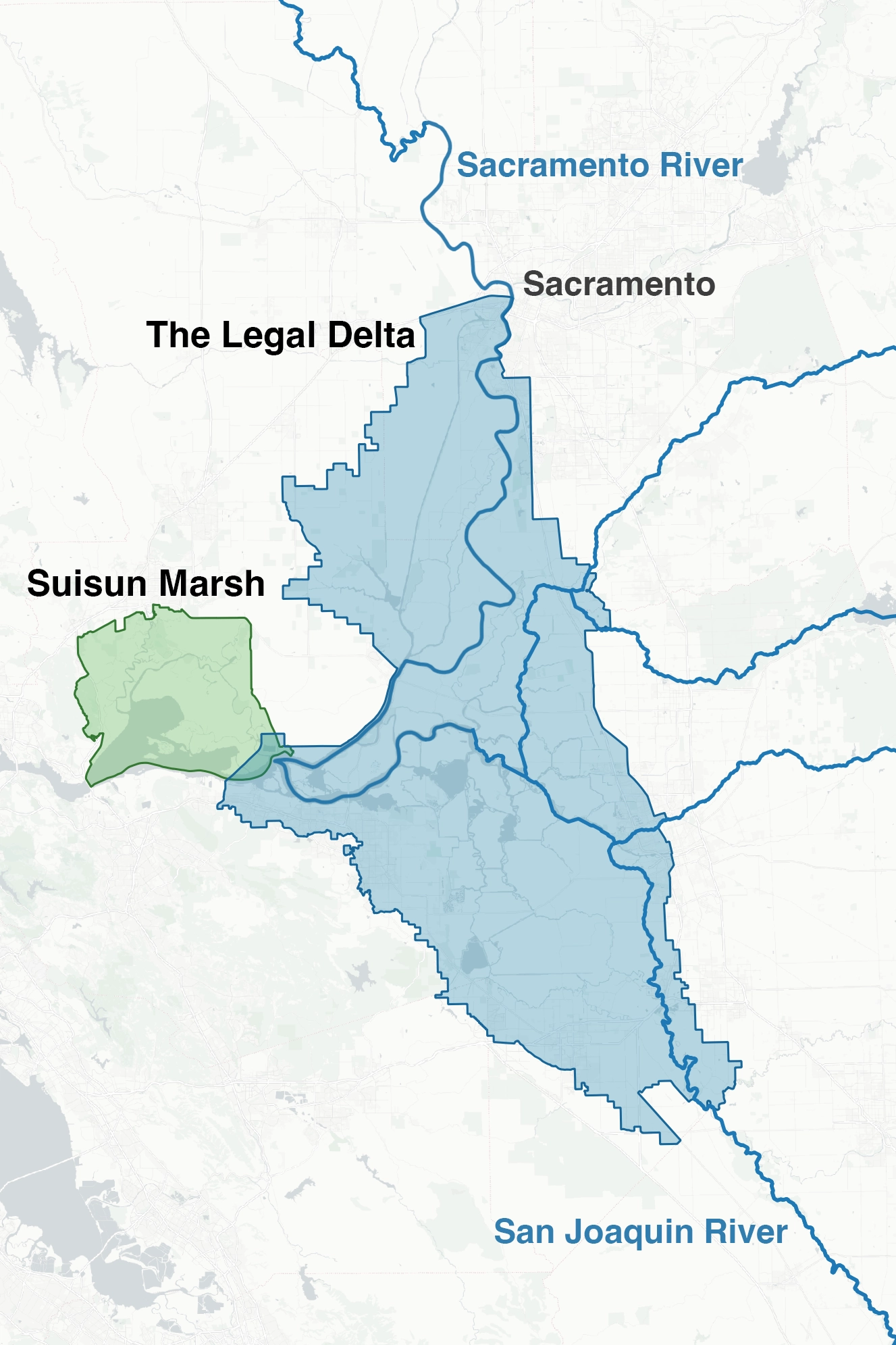
California is a leader in aspirational climate goals, and in the Sacramento-San Joaquin Delta, some of those aspirations now are specific, legally established targets. The state's Nature-Based Solutions Climate Targets, developed under Assembly Bill 1757, call for re-wetting 50,000 acres of subsided Delta peat soils by 2045 to meet the state's carbon neutrality goal and reduce anthropogenic greenhouse gas emissions. In addition, The Delta Plan has a goal of restore 60,000–80,000 acres of habitat by 2050. Home to over 600,000 people across its 738,000 acres, the Delta is essential to California’s agricultural engine. Not only is the majority of the Delta used for agriculture like alfalfa, rice, tomatoes, and winegrapes, but water in the Delta further supports California’s $50 billion agricultural industry by being a water source for more than 1,800 agricultural users. At the same time, the Delta faces local and global risks: the drainage of Delta peat soils releases up to 1.2 million metric tons of carbon annually, and the resulting subsidence threatens the levees that protect local communities, millions of acres of agriculture, and a portion of the water supply for more than 27 million Californians. Restoration is among the most direct tools the state has to reverse these effects. Whether the targets are met on time, however, comes down to how quickly and cost-effectively projects reach implementation.
Restoration in the Delta is uniquely difficult to permit. Projects must satisfy numerous agencies, accommodate the needs of sensitive species, and navigate the Delta’s unique balance of interests: residents, ecosystems, agriculture, statewide infrastructure, and water. Over the last decade, California has built restoration-specific permitting tools designed to ease this burden. The statewide Cutting Green Tape (CGT) initiative served as a major catalyst for existing efforts, helping institutionalize a new model with dedicated staff for restoration permitting and expe meaningful time and cost savings for restoration projects. This paper examines how well these permitting tools are working in the Delta, where they fall short, and what more is needed to accelerate restoration at the pace and scale the state's climate and habitat goals require.
Not all requirements apply to every project — applicability depends on project activities, location, and scope.
- Endangered Species Act (USFWS)
- Endangered Species Act (NMFS)
- National Environmental Policy Act
- Clean Water Act Sec. 404 (Army Corps)
- Rivers and Harbors Act Sec. 408 (Army Corps)
- National Historic Preservation Act Sec. 106 (SHPO)
- Clean Air Act (AQMD)
- U.S. Coast Guard, Advance Approval Notification
- U.S. Bureau of Reclamation — Facility Relocation Agreement
- CA Environmental Quality Act (CEQA)
- CA Endangered Species Act (CDFW) RMP
- Fish and Game Sec. 1600 Lake & Streambed Alteration RMP
- Common Species / Species of Special Concern and Scientific Collecting Permit (CDFW) RMP
- Fully Protected Species (CDFW) RMP
- Native Plant Protection Act (CDFW) RMP
- Clean Water Act Sec. 401 Water Quality Certification (Water Boards)
- Clean Water Act Sec. 402 NPDES (Water Boards)
- Porter-Cologne Water Quality Act (Water Boards)
- AB 360: Delta Levees Program (DWR/CDFW)
- Conservation easements
- Farmland designations
- Williamson Act
RMP Qualifying projects may seek coverage under a single CDFW Restoration Management Permit.
- Certification of Consistency with the Delta Plan (Delta Stewardship Council)
- Local air district air quality laws
- CalTrans Encroachment Permit
- Central Valley Flood Protection Board Encroachment Permit
- Flowage Easement for mitigation banks (Central Valley Flood Protection Board)
- Land Use and Resource Management Plan (Delta Protection Commission)
- Grading Permit (City/County)
- Conditional Use Permit (City/County)
- Zoning (City/County)
- Underground pipeline access / right of way, utility relocation agreement (utility companies)
- SF Bay Conservation and Development Commission (BCDC) permit Suisun Marsh only
- HCPs/NCCPs (Eastern Contra Costa County, Yolo County)
- Central Contra Costa County Sanitary District Discharge Permit
Key Findings
Drawing on surveys and interviews with 27 organizations involved in Delta restoration, the analysis finds that restoration-specific pathways deliver real, measurable benefits when used as designed: nearly two-thirds of project proponents reported time savings and more than half reported cost savings, with individual projects saving as much as 12 to 16 months and potentially millions of dollars. The evidence that these tools can work is clear.
The findings that follow examine why these benefits are not yet the norm in the Delta. They fall into three broad groups: tools that exist but are applied inconsistently, constraints that are genuinely difficult to resolve, and the local trust and coordination that no permit can deliver on its own.
1Inconsistent use and implementation of restoration-specific permitting tools
A central issue is the uneven application of existing restoration tools. Survey respondents noted inadequate staff training, staff turnover, perceived risk, and ambiguity within agencies about when newer tools like the CEQA Statutory Exemption for Restoration Projects (SERP) and Restoration Management Permit (RMP) apply. The result is that projects that do qualify for restoration-specific pathways sometimes are subject to traditional permitting, and those that do use restoration-specific pathways can still take as long and cost as much as if they had gone the traditional route due to additive requirements or inconsistent application.
Applicants pointed to a need for established systems of institutional learning that incorporate lessons learned, which can consolidate what has worked across completed projects so agencies can scale the practices rather than relying on knowledge that leaves with departing staff. Restoration-focused teams like CDFW’s CGT team and the NOAA Restoration Center were widely valued for exactly this reason, but equivalent teams do not exist at every permitting agency, leaving proponents without a consistent point of technical support across the full set of approvals a project requires. Risk aversion by agency staff and the need to get more expedient decisions on complex policy questions from agency leadership are also a factor.
2Not all agencies have adequate restoration-specific pathways
Because a project needs approval from every agency involved, one agency without a restoration pathway can stall implementation and erase efficiency gained elsewhere. For example, the Central Valley Flood Protection Board (Flood Board), which as the non-federal sponsor, typically must receive Section 408 permission before issuing their encroachment permit, faces review demands and reported staff shortages. The Flood Board is currently undertaking a rulemaking process to better align regulations with restoration and that process is expected to conclude in 2027.
In Suisun Marsh, the San Francisco Bay Conservation and Development Commission (BCDC) has some streamlined processes for small projects, however most restoration projects have to undertake the more involved process to obtain a “major permit.” BCDC is also actively analyzing and developing approaches for a programmatic restoration permit to expedite project approval.
3Addressing unique species-related permitting challenges in the Delta
Avoiding and minimizing impacts to special-status species is an important part of responsible habitat restoration; however, in some Delta and Suisun settings, fully addressing those impacts at the individual project level can be exceptionally difficult or costly, even where the project is expected to provide substantial overall ecological benefits. This can create conflicts between natural resource objectives and varied agency application of regulations that can result in delayed permits, difficulties in demonstrating net-benefit to biodiversity, and uncertain mitigation requirements that may be hard to satisfy given limited suitable land and willing landowners.
Another complicating factor is that restoring wetlands on reclaimed agricultural land is central to addressing subsidence and carbon emissions, but those lands are foraging habitat for birds like the CESA-listed Swainson’s hawk and mitigation may be required for conversion of those lands. In addition to convening a broader interagency working group, DWR’s in-progress Regional Conservation Investment Strategy offers a potential route to address some of these conflicts at a landscape-scale rather than project by project.
4Challenges for permitting and implementing mitigation projects
Mitigation projects sometimes struggle to demonstrate eligibility for restoration-specific permitting processes. The RMP requires projects to have a substantial net benefit above a baseline that includes required mitigation activities, and because the permit took effect in January 2025, neither CDFW nor applicants have extensive experience applying it to mitigation projects.
Habitat requirements tied to Delta Levees Program funding add another layer, with AB 360’s net long-term habitat improvement standard interpreted by some respondents as excessive and difficult to reconcile with restoration permitting tools. Marketplace constraints are another issue, with scarce available credits for species like giant garter snake where the demand is high, and finding land to create mitigation banks is getting harder.
5High costs of project implementation, monitoring, and lack of sufficient funding
One-third of project proponents named cost as one of the major challenges of planning, permitting, and implementing restoration in the Delta and Suisun Marsh, with species mitigation, biological monitoring, and lengthy competitive grant cycles all contributing. The Delta Conservancy estimates a $2 billion need ($1 billion for restoration and $1 billion for levee work) against which recent Proposition 4 allocations of $29 million to the Conservancy and $150 million to DWR fall well short. General obligation bonds, the primary vehicle for this work, can cost the state close to double the principal.
Few grants cover long-term operations and maintenance, and while agencies want longer-term monitoring to quantify restoration’s benefits Delta-wide, applicants view monitoring beyond demonstrating their own project’s success as cost-prohibitive without an alternative funding source.
6Coordination with local interests and land use planning
Delta governance reflects a shared priority around agricultural protection across DWR, CDFW, the Delta Stewardship Council, the Delta Protection Commission, and the counties, and restoration proponents must engage with all of it. Taking land out of production may reduce county tax revenue, impact agricultural jobs, and strain reclamation districts funded by assessments on farmed land, with additional landowner concerns about seepage, flooding, invasive species, and crop damage from increased wildlife.
Subsidence and flooding will require some land to come out of production or be replaced with alternative practices. Options like growing rice and other forms of paludiculture or the rewetting of subsided peat while keeping land in production and generating revenue for levee maintenance offer a partial answer, as exemplified by the Staten Island and Webb Tract whole-island demonstration projects. Early engagement remains the most reliable indicator of durable projects, yet consideration of the Good Neighbor Checklist used for engaging local interests was documented in only about one quarter of relevant Delta Plan certifications since 2023, and local frameworks like the Delta Protection Commission’s LURMP require updating to meet the pace of restoration and climate change now underway.
7Conduct early, often, and meaningful Tribal engagement and consultation
Restoration projects can offer Tribes opportunities for cultural resource protection and revitalization, access to gather culturally important plants, and potentially greater co-management of Delta lands. These opportunities are best realized when engagement begins in early planning and, where feasible, before land is acquired.
Metropolitan Water District’s Webb Tract project showcases what that can look like: an Ecocultural Working Group co-led by Tribal cultural bearers, where participants were paid for time and travel, and were able to propose a design change that enabled protection of cultural resources produced.
8Anticipated difficulties finding a federal nexus for Section 7 Endangered Species Act compliance
Following Sackett v. EPA, fewer projects will require a Clean Water Act 404 permit from the Army Corps, which historically served as the gateway to interagency consultation under Section 7 of the federal Endangered Species Act. Without it, projects not receiving federal funding or significant federal involvement will require proponents to pursue compliance through Section 10, a substantially longer and more complex process.
Thirty-eight percent of survey respondents expect the changed WOTUS definition to negatively affect their projects, and most have no alternative plan for establishing a federal nexus. Without one, the efficient and much less expensive USFWS’ Statewide Restoration Programmatic Consultation cannot be used, regardless of how well it fits the project.
Recommendations
Across these findings, several cross-cutting priorities emerge. The full set of recommendations, with references to relevant, responsible agencies, appears in the Recommendations Table.
- 1.1, 4.1, & 7.1 Agency leaders actively implement the Secretarial Memo on Institutionalizing Cutting Green Tape Improvements to guide and support staff to consistently and effectively use restoration-specific permitting tools (e.g., RMP, SRGO, etc.), including for mitigation projects. Findings 1, 4, & 7
- 1.3 State agencies develop an agency-wide training program for regional management and staff at state agencies to support comprehensive and consistent implementation of restoration-specific permitting tools. Finding 1
- 2.1–2.4 Fill the gaps for agencies to either develop or renew restoration-specific permitting processes, and establish consistent processes with expedited approval timelines and staffing to meet the timelines. Finding 2
-
3.1
CNRA, in collaboration with DSC and Delta Conservancy, convene agencies to resolve conflicts to enable restoration in the Delta, while also protecting special-status species, supporting climate resilience, and maintaining viable agriculture (the Delta Plan Interagency Implementation Committee Restoration Subcommittee could be a potential existing forum for these convenings).
The effort should identify specific actions to address habitat conversion, mitigation, work windows, monitoring, and other species-related challenges and provide guidance on geographic priority areas for restoration in the Delta. Swainson's hawk and garter snake are priority species to discuss. Include input from CDFW, USFWS, the California Air Resources Board, California tribes, and local interests (e.g., Delta Protection Commission, Delta Conservancy, Delta Counties Coalition, Delta Stewardship Council, California Department of Water Resources). This planning effort should consider neighboring Habitat Conservation Plans/Natural Community Conservation Plans (HCPs/NCCPs) in San Joaquin, Sacramento, Yolo, Solano, and Contra Costa Counties, and Nature-Based Solutions Climate Targets for the Delta and whether this planning effort could be advanced through DWR's development of a Regional Conservation Investment Strategy (RCIS) for their Delta Levees Program.
Finding 3 - 5.1 Agency leadership, California Governor, and State Legislature create steady funding for Delta restoration through the general fund, Greenhouse Gas Reduction Fund, and additional funding sources to ensure necessary funding to meet the Delta Plan restoration targets. Finding 5
- 7.1 Agency leadership actively implement the Secretarial Memo on Institutionalizing Cutting Green Tape Improvements related to upholding early, often, and meaningful Tribal consultation as outlined in the CNRA Tribal Consultation Policy and the CalEPA Tribal Consultation Policy. Finding 7
The Path Forward
This white paper is a collective call to action for restoration project proponents, agency officials, environmental organizations, and communities. The progress made so far is a testament to the power of collaborative efforts across these groups. To sustain the momentum, agency leadership should engage in the focused dialogue needed to overcome the remaining challenges to scale up restoration. These challenges include resolving policy, funding, and organizational hurdles; ensuring effective agency staff training and applicant technical assistance; managing perceived risks associated with working in sensitive habitats; and shifting from reactive to proactive restoration strategies.
By building on recent successes, committing to innovation, and collaborating effectively, we can ensure that regulatory processes and programs enable ecological restoration at the pace and scale needed to fix existing problems and prepare for an uncertain climate future. Together, we can support the restoration of California’s ecosystems to benefit the environment and the communities that depend on them.
Acronyms used in this post
- AQMD
- Air Quality Management District
- BCDC
- San Francisco Bay Conservation and Development Commission
- CDFW
- California Department of Fish and Wildlife
- CEQA
- California Environmental Quality Act
- CESA
- California Endangered Species Act
- CGT
- Cutting Green Tape, the statewide initiative to streamline restoration permitting
- CNRA
- California Natural Resources Agency
- DWR
- California Department of Water Resources
- ESA
- Endangered Species Act
- HCP / NCCP
- Habitat Conservation Plan / Natural Community Conservation Plan
- LURMP
- Land Use and Resource Management Plan (Delta Protection Commission)
- NMFS
- National Marine Fisheries Service
- NPDES
- National Pollutant Discharge Elimination System
- RMP
- Restoration Management Permit, issued by CDFW
- SERP
- CEQA Statutory Exemption for Restoration Projects
- SHPO
- State Historic Preservation Officer
- SRGO
- Statewide Restoration General Order
- USFWS
- U.S. Fish and Wildlife Service
- WOTUS
- “Waters of the United States,” the Clean Water Act jurisdictional definition narrowed by Sackett v. EPA