Drone footage of a Central Valley orchard with cover crops. Pusher HQ
Cover Cropping in California’s Water-Scarce Environments
Sustainable Conservation and partners have released three new fact sheets expanding the Cover Cropping in California’s Water Scarce Environments series with in-depth guidance for three distinct cropping contexts California growers are navigating across the Central Valley’s varied regions and weather years:
Each fact sheet combines the latest research with grower experience on the ground, going well beyond general cover crop guidance to meet farmers where they are. The suite builds on the foundation of practical considerations for managing cool-season cover crops with maximal water benefits and minimal water use laid out in the May 2025 guidance document, and extends it with a depth of context, data, and practical implementation detail.
These fact sheets are focus on water management in three different land management scenarios in California. They are a great resource for farmers and land managers who want to build soil health while farming in our water scarce environment. Sarah E Light, Agronomy Farm Advisor (UC Agriculture and Natural Resources)
Three Scenarios, Three Guides
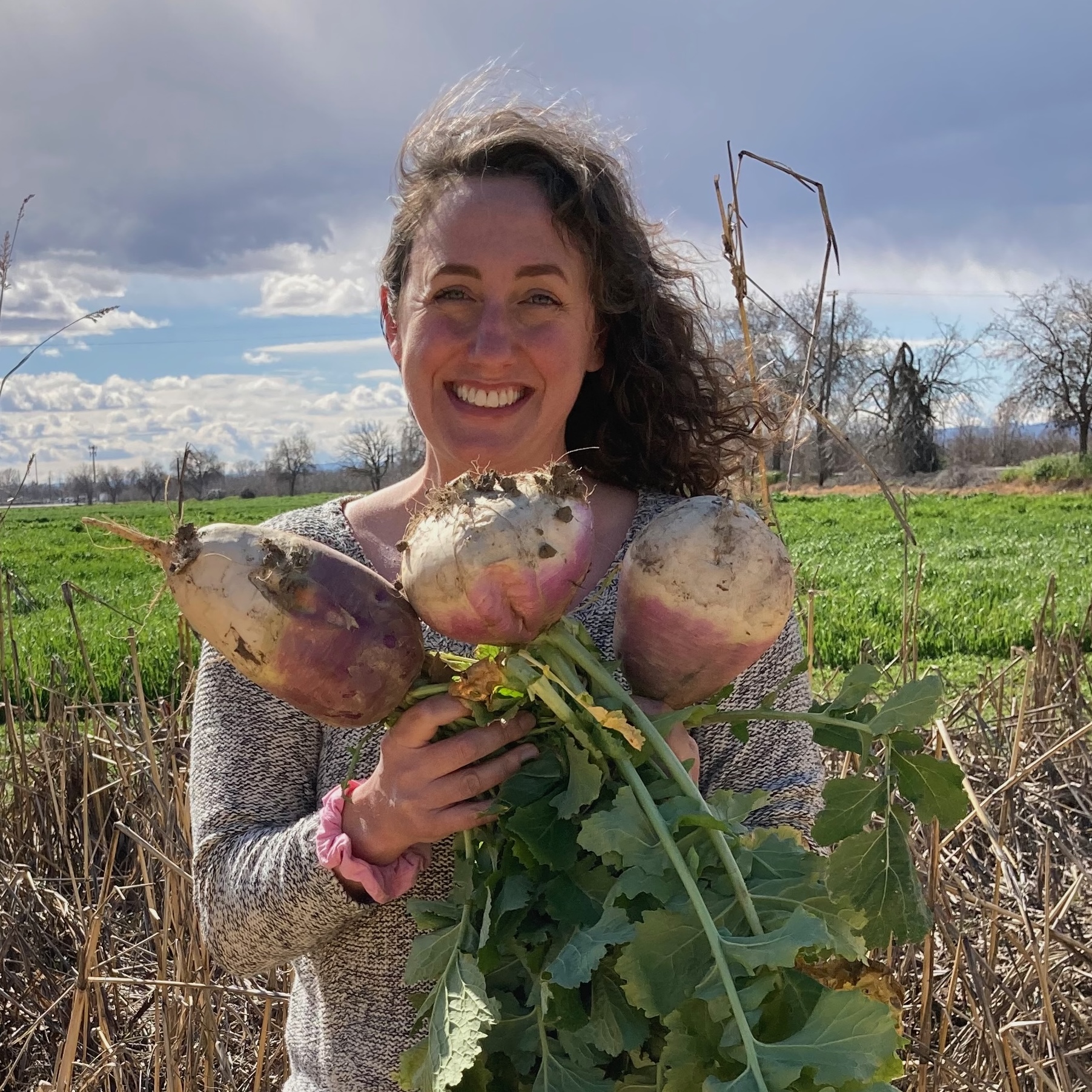
Cover Cropping Beyond Winter in Perennial Systems — What actually happens with water if cover crops aren’t terminated in spring? Developed in partnership with Tanya Gemperle of the UC Davis Gaudin Lab, this fact sheet draws on climate research, soil health data, and interviews with growers in Kern County, Madera County, and Lodi to examine the water dynamics, soil benefits, residue management strategies, and species selection considerations that shape whether year-round cover makes sense for a given operation. It finds that with the right management approach, extended cover can deliver year-long, sustained benefits to soil structure, organic matter, biodiversity, and farm resilience.
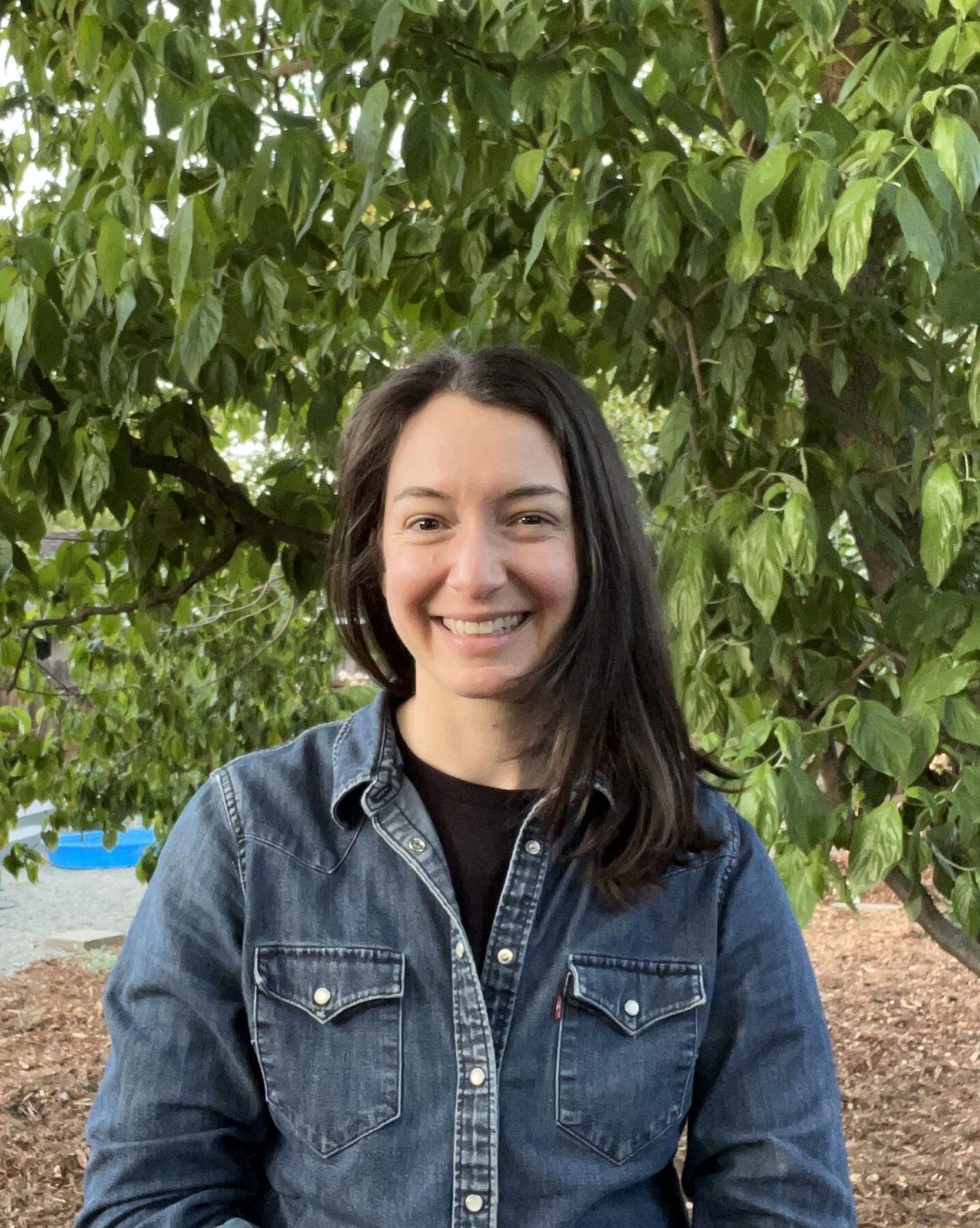
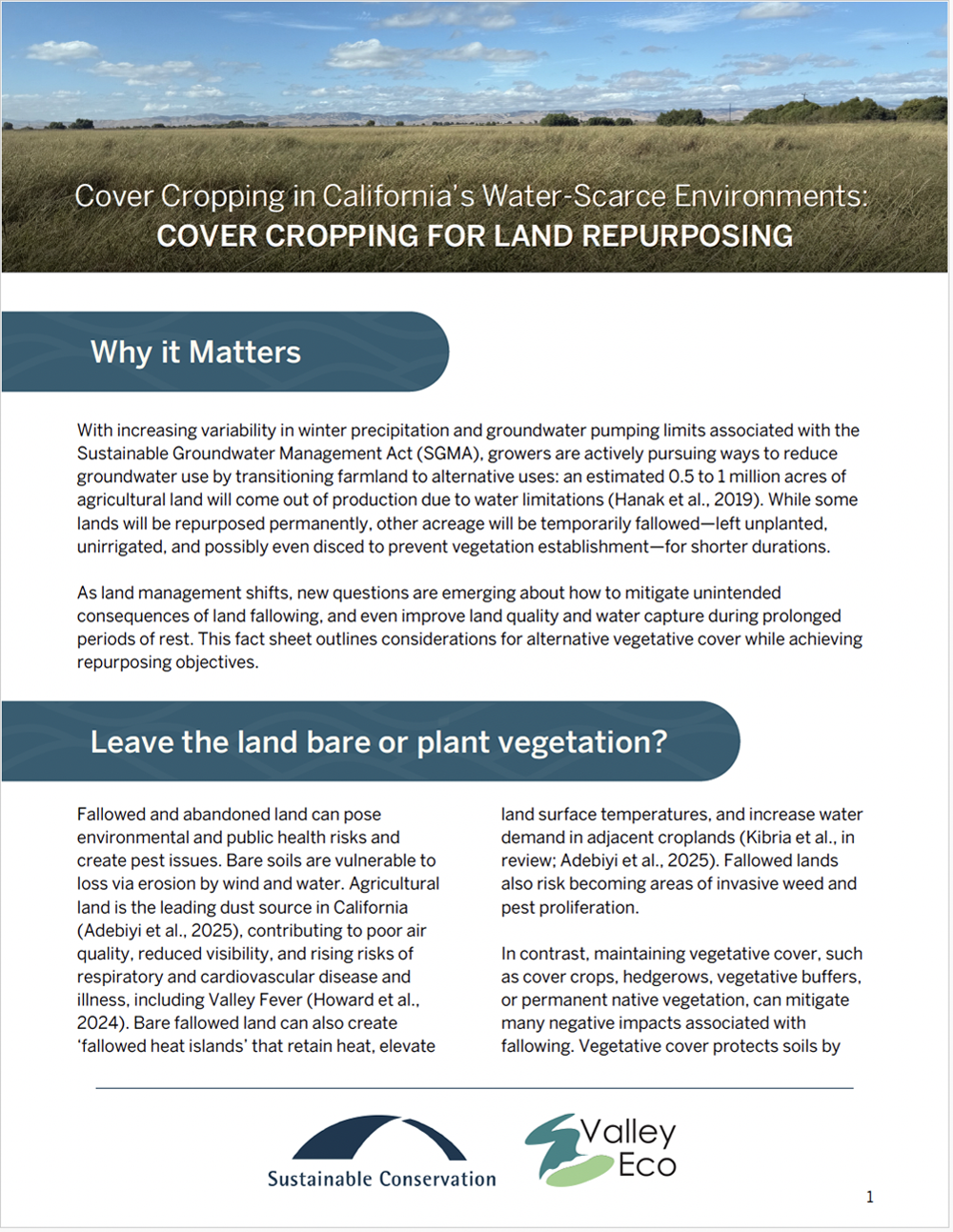
Cover Cropping for Land Repurposing — As SGMA drives land out of irrigated production, growers and landowners need practical guidance on what to put in its place, and a reminder why leaving it bare carries real costs. The fact sheet frames a range of options, from short- and long-term cover cropping, dryland crops to grazing rangeland, native habitat restoration, and solar co-location with vegetation. It provides guidance on species selection, management approach, and which strategy best fits a site’s goals and constraints. Developed in partnership with Dr. Britne Clifton of Valley Eco, it draws on ecological research, grower conversations, and the growing body of science on vegetation’s role in soil protection, air quality, and local cooling on fallowed lands.
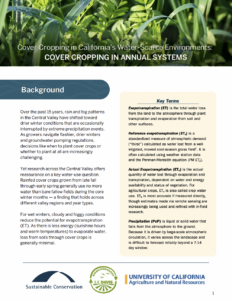
Cover Cropping in Annual Systems — Drawing on original field measurements conducted by the UC Davis Biometeorology Group at experimental sites across the Sacramento Valley, the Delta, and the San Joaquin Valley. This resource gives annual crop growers a clearer picture of how cover crop water use relates to regional precipitation patterns and evaporative demand across weather years, where termination timing matters most, and how to weigh the tradeoffs between biomass accumulation and soil moisture conservation for the following cash crop.
Cover crops are a flexible multi‑benefit tool that can be adapted across perennial orchards, annual crop rotations, and a variety of contexts for land repurposing. They support soil health, water dynamics, and agroecological function. In a future with extended dry spells and flashier precipitation, covered ground across these diverse contexts, can help us to capture more precipitation and keep soils in place—supporting resilient, productive landscapes while addressing the evolving challenges of water scarcity, soil degradation, and land transition. Sarah Castle, Principal Scientist (Sustainable Conservation)
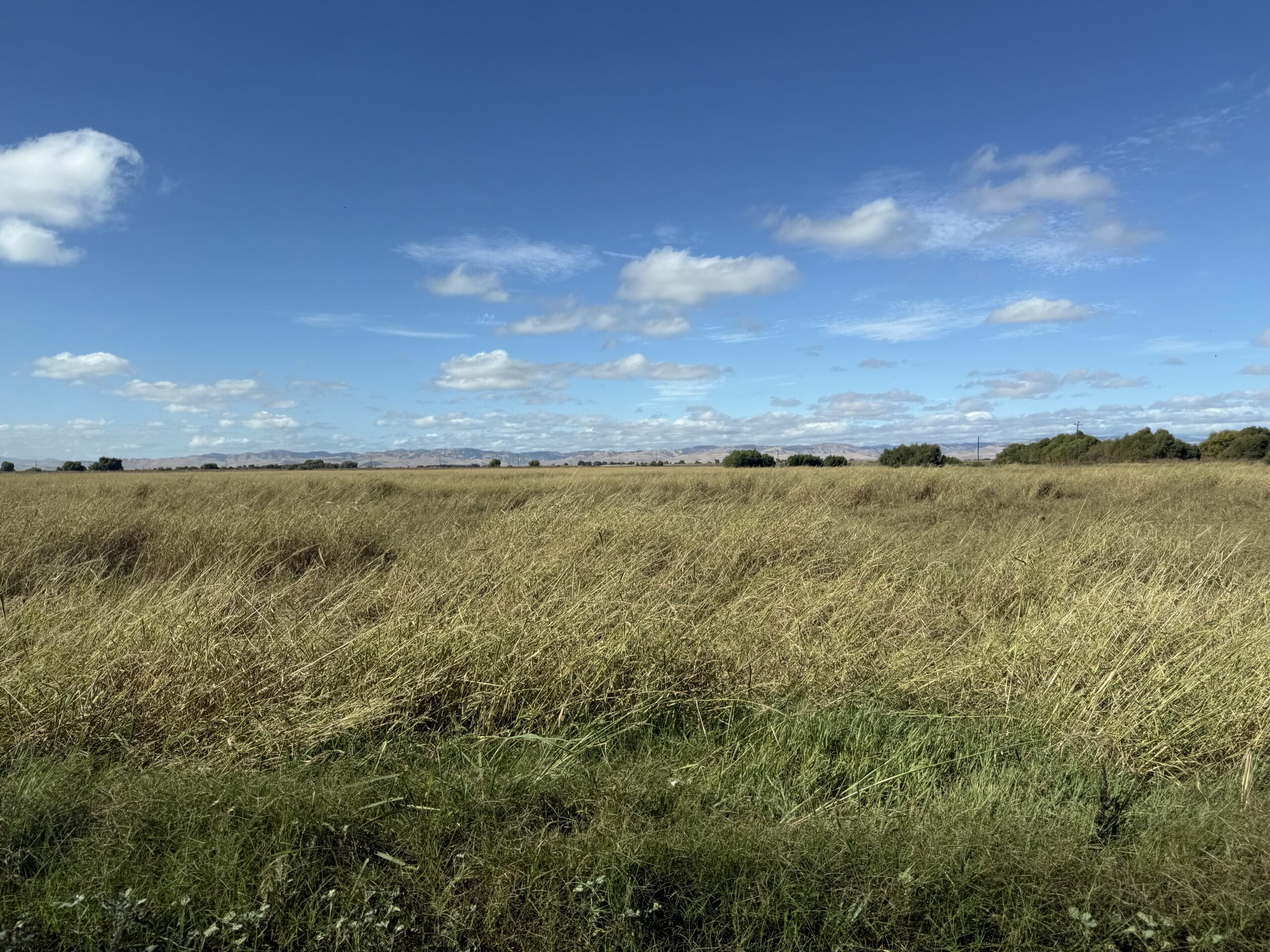
Restored grassland and seasonal wetland, planted primarily with grass-species-focused cover crops. Managed by CDFW in Merced County.
Acknowledgments
These fact sheets reflect the contributions of a broad community of researchers, farmers, technical advisors, and practitioners. Sustainable Conservation thanks the many authors and reviewers, including contributors from the UC Davis Gaudin Lab and Biometeorology Lab, UC Agriculture and Natural Resources (UC ANR), and Valley Eco, as well as review from UC ANR, the USDA Natural Resources Conservation Service, UC Davis, and the UC Organic Agriculture Institute. Special thanks to the growers who generously shared their time and experience.
Funding for this resource was made possible in part through support from The California Department of Food and Agriculture (CDFA). Its contents are solely the responsibility of the authors and do not necessarily represent the official views of the CDFA.
About Sustainable Conservation
For over 30 years, Sustainable Conservation has united people across business, agriculture, and government to steward California’s vital natural resources. Our programs promote practical solutions that enhance environmental and economic sustainability, focusing on water, land, and air quality. For more information, visit www.suscon.org and follow us on Twitter, LinkedIn, Facebook, Instagram, and YouTube.