
- California experienced its worst drought in 1,200 years from 2012 to 2016. This severe multi-year event triggered the first mandatory statewide water conservation measures in the history of the state.
Read full summary ▾
- Dry cycles cause parts of the Central Valley to sink by several feet. This land subsidence from heavy groundwater pumping damages crucial public infrastructure like roads, bridges, and canals.
- Climate change drives roughly 80% of the recent surge in atmospheric moisture demand across the western United States. Rising heat acts as the single biggest factor making modern droughts much more severe.
- Aquifers supply up to 60% of California’s water during dry years. Because of this heavy reliance, replenishing underground reserves through groundwater recharge is central to surviving repeated dry periods.
This article covers the specific historical timeline, climate patterns, and compounding economic consequences of California’s recurring droughts and dry cycles. In addition, we discuss how modern replenishment strategies like groundwater recharge help build long-term water resilience.
In California, drought has affected water policy, agriculture, and communities for as long as records exist. To understand where California stands today, it helps to start with the basics: what drought actually is, how it fits into the broader story of drought in the United States, and what the state’s own historical record looks like.
At Sustainable Conservation, we have spent decades working alongside California farmers, water managers, and communities to build a more water-resilient state. That work has given us a close-up view of how drought shapes decisions on the ground and why understanding its history matters for planning what comes next.
- What is drought?
- What are the most significant droughts in US history?
- Why is California especially vulnerable to drought?
- What are the historical droughts in California?
- What are the effects of repeated droughts?
- How Sustainable Conservation is responding to California's drought challenge
- Frequently asked questions (FAQs)
What is drought?
Drought does not announce itself the way a hurricane or wildfire does. It is often called a “creeping phenomenon” because it builds slowly, affecting water supplies, crops, ecosystems, and economies over months or years rather than days.
There’s no single definition that every agency or country agrees on, but the core idea is that drought happens when an area receives significantly less water than it normally would over an extended period of time.
What are the different types of drought?
Scientists usually sort drought into a few categories depending on what part of the water system is affected:
- Meteorological drought is the starting point. It simply means less rain or snow than normal has fallen over a region. Everything else flows from here.
- Agricultural drought follows when that lack of rainfall depletes the moisture in the soil to the point where crops cannot grow properly. Livestock are also affected when water for grazing and feed runs low.
- Hydrological drought develops when rivers, lakes, reservoirs, and groundwater supplies drop below their normal levels. This type tends to lag behind meteorological drought because it takes time for reduced rainfall to work its way through the broader water system.
- Socioeconomic drought occurs when water shortages start to affect the wider economy, driving up costs, cutting agricultural output, and straining public water supplies.
In practice, these types overlap, and a prolonged stretch of dry weather will usually trigger all four in sequence.
What are the most significant droughts in US history?
Drought, though common in California, is not unique to it. It’s a normal climate pattern that has occurred in varying degrees of length and severity throughout history.
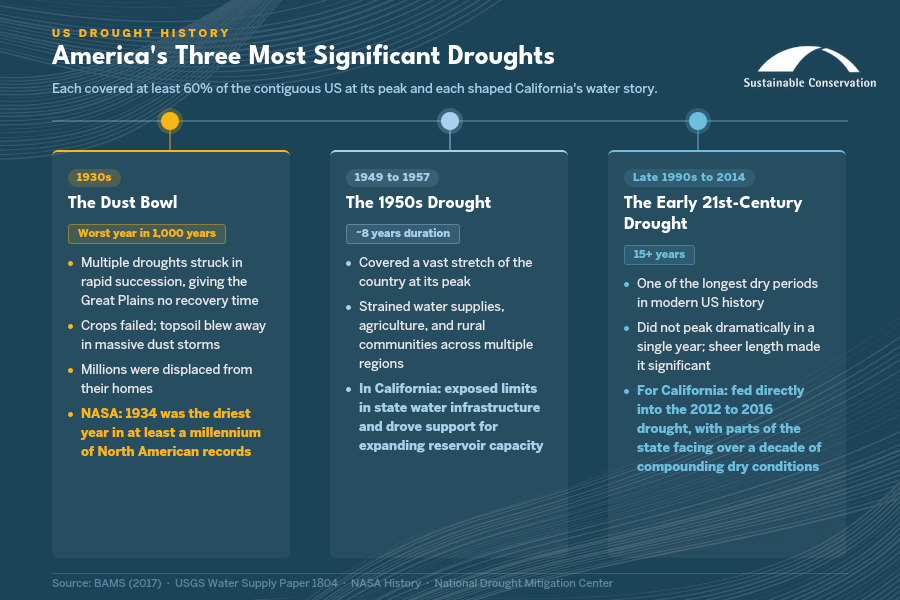
Researchers have identified more than a dozen major drought episodes across the contiguous United States between 1900 and 2014. A 2017 study found three that stood out for their duration and geographic reach:
- The 1930s Dust Bowl
- The 1950s drought
- A prolonged dry period that stretched from the late 1990s into 2014
Each of these covered at least 60 percent of the contiguous US at its peak.
The Dust Bowl
When scientists and historians talk about drought in the United States, the 1930s Dust Bowl is always the reference point. It remains the most significant meteorological and agricultural drought in the nation’s recorded history, concentrated in the Great Plains states but felt far beyond them.
It was actually several distinct droughts hitting in such rapid succession that affected regions never had a chance to recover between them. Crops failed, topsoil blew away in massive dust storms, and the economic collapse deepened an already severe Great Depression. Millions of people were forced to leave their homes. NASA research later found that 1934 was the driest and most widespread drought year in at least a thousand years of North American climate records.
It was also not purely a natural disaster. Decades of plowing up native grassland had left the soil with nothing to hold it in place once the rains stopped, a reminder that how land is managed can determine how drought damages it.
The 1950s Drought
The 1950s drought was another major event in the national record, running roughly from 1949 to 1957. Like the Dust Bowl before it, it covered a vast stretch of the country at its peak and lasted long enough to strain water supplies, agriculture, and rural communities across multiple regions.
In California, the period contributed to growing pressure on the state’s water infrastructure and helped drive support for expanding reservoir capacity and water delivery systems in the years that followed.
The Early 21st-Century Drought (Late 1990s to 2014)
The third of the country’s longest drought episodes on record stretched from the late 1990s through 2014, making it one of the most prolonged dry periods in modern US history. Unlike the Dust Bowl, it did not peak as dramatically in a single year, but its length made it significant.
For California, this period overlapped with and set the stage for some of the severe drought conditions the state experienced in the early 2010s, meaning parts of the state were dealing with compounding dry conditions for well over a decade before the 2012 to 2016 drought took hold.
Why is California especially vulnerable to drought?
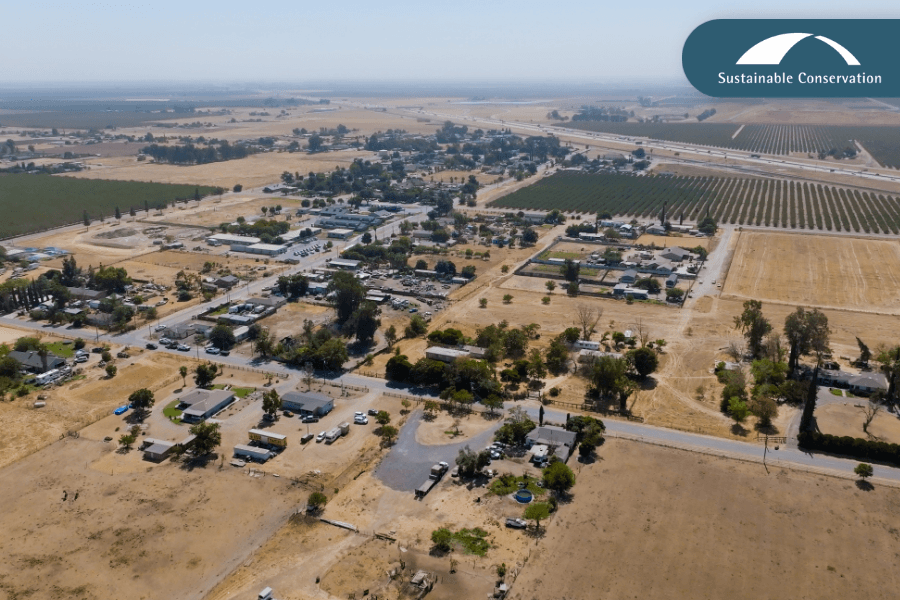
California’s relationship with water is largely affected by its climate. The state has what is called a Mediterranean climate: wet winters and dry summers. Nearly all of the rain and snow that falls in California arrives between October and April, and then the rest of the year is almost entirely dry.
That pattern makes the state heavily dependent on storing winter precipitation and using it through the summer and fall. One of the most important storage systems is the Sierra Nevada snowpack, which accumulates over the winter and slowly releases water as it melts in spring and summer, feeding rivers, streams, and reservoirs.
The important role of snowpack
When drought hits, less snow accumulates in the mountains. And when the reduced snowpack does melt, it tends to soak into dry soil rather than flowing into rivers and reservoirs. That compounds the problem: not only is there less water coming in, but less of what does fall ends up in storage where it can actually be used.
Why multi-year droughts are so damaging
California also has extensive water infrastructure and groundwater systems that can buffer the effects of a single dry year. A single dry year is generally not a drought for most Californians because those buffers absorb the shortfall. Drought becomes a serious problem when dry years stack up, drawing down reserves that take years to replenish and putting pressure on the groundwater supplies that millions of Californians and farmers depend on.
What are the historical droughts in California?
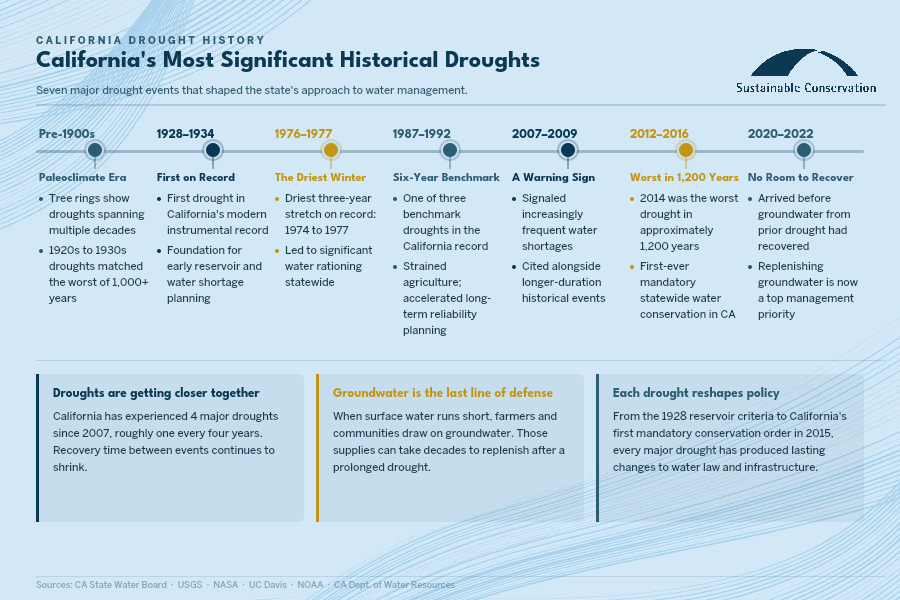
California has experienced numerous droughts throughout its history, but some have had a particularly significant impact on the state’s water supply, agriculture, economy, and communities. Below are some of the most notable drought events in California:
Paleoclimate evidence (before the modern record)
California’s drought history extends well beyond the written record. Scientists use evidence preserved in tree rings to reconstruct past climate conditions. Paleoclimate records going back over a thousand years show many significant dry periods, and the droughts of the 1920s and 1930s were on par with the largest multi-decade droughts in that much longer record.
The 1928 to 1934 Drought
The first major drought captured in California’s modern instrumental record lasted approximately seven years, from 1928 to 1934. Because it was the first on record, it became the foundation for early reservoir planning and the development of water shortage criteria that water managers still build on today. It also predated much of the state’s current water infrastructure, including the Federal Central Valley Project and the State Water Project.
The 1976 to 1977 Drought
Among California’s more recent droughts, the mid-1970s drought stands out for how dry conditions became in a short period. California’s driest three-year stretch on record ran from 1974 to 1977, and the 1975 to 1976 winter was the driest single winter the state had recorded at that point. The drought led to significant water rationing and pushed water agencies and state policymakers to think more seriously about conservation planning.
The 1987 to 1992 Drought
This six-year drought from 1987 to 1992 is one of the benchmark events that researchers use when comparing California’s major dry periods. It’s grouped with the 1928 to 1934 drought and the 2012 to 2016 drought as the three most significant in terms of duration and impact on both rainfall and runoff. The drought put significant pressure on agricultural water supplies in the Central Valley and accelerated conversations about long-term water reliability in the state.
The 2007 to 2009 Drought
A shorter but notable dry period, the 2007 to 2009 drought contributed to growing recognition that California was facing increasingly frequent water shortages. State water managers list it among the notable historical drought events alongside longer-duration events, even if it didn’t reach the same scale.
The 2012 to 2016 Drought
The 2012 to 2016 drought is one of the most studied in California’s history and, by several measures, one of the most severe. The conditions in 2014, in particular, drew significant scientific attention. Researchers found it was the worst drought in approximately 1,200 years, based on climate reconstructions.
The drought affected water supplies across the state, reduced streamflow and reservoir levels, and accelerated groundwater depletion in the Central Valley as agricultural users drew more heavily on wells to compensate for reduced surface water. It prompted the first mandatory statewide water conservation measures in California history.
The 2020 to 2022 Drought
California had barely recovered from the previous drought when the next one arrived. Groundwater may not have fully recovered from the 2012 to 2016 drought before the 2020 to 2022 drought began, a sign of how little breathing room exists between major events.
That drought depleted reservoirs, triggered another round of water use restrictions, and drove up wildfire risk across the state. Replenishing those depleted groundwater supplies has become one of the central water management challenges in California today.
What are the effects of repeated droughts?
California’s long drought history has not been without consequence. Each major dry period leaves behind a set of compounding problems, many of which do not fully resolve before the next drought begins.
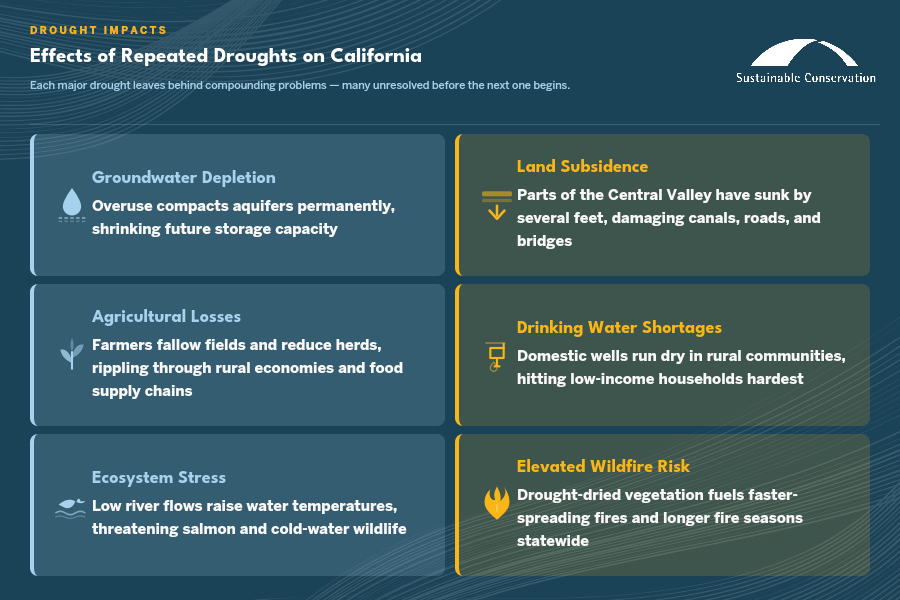
- Groundwater depletion. When surface water runs low, farmers and communities pump more from underground aquifers. Over time, this overuse causes aquifers to compact, reducing their capacity to hold water in the future.
- Land subsidence. Heavy groundwater pumping during drought periods has caused parts of the Central Valley to sink by as much as several feet in some areas, damaging infrastructure like canals, roads, and bridges.
- Agricultural losses. Reduced water availability forces farmers to fallow fields, switch to less water-intensive crops, or reduce herd sizes. These decisions ripple through rural economies and food supply chains.
- Drinking water shortages. Drought conditions put domestic wells at risk of going dry, particularly in low-income rural communities that rely on shallow groundwater and have fewer alternatives when supplies run out.
- Ecosystem stress. Reduced river flows during drought affect water temperatures, sediment movement, and habitat availability for fish and wildlife. Species like salmon, which depend on cold, fast-moving water, are especially vulnerable.
- Elevated wildfire risk. Drought dries out vegetation across the landscape, creating conditions where fires start more easily and spread more quickly. The connection between California’s drought cycles and its worsening fire seasons is increasingly well-documented.
How Sustainable Conservation is responding to California’s drought challenge
Sustainable Conservation’s work is built around the reality that drought in California is not going away. Instead, the question is how well-prepared the state is when the next one arrives.
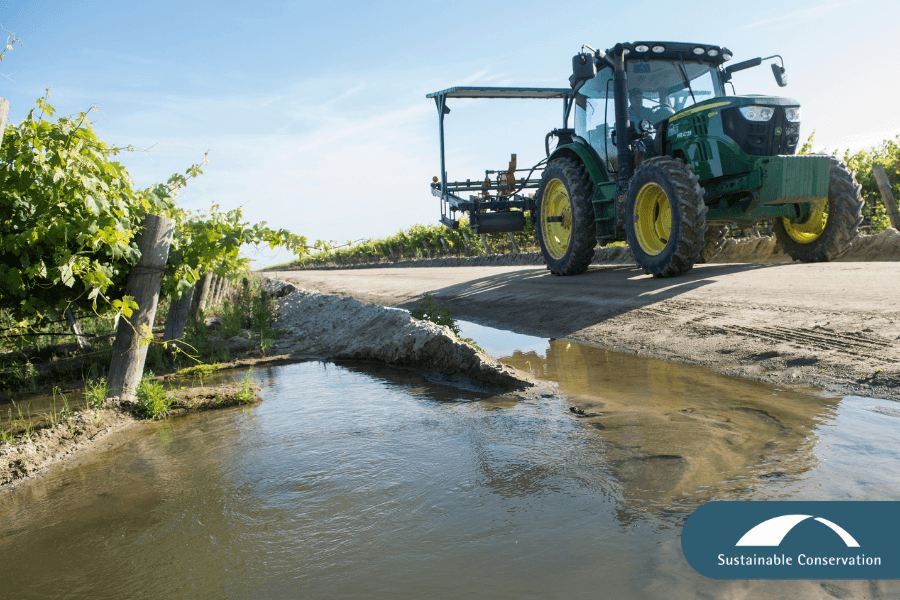
- Rebuilding groundwater supplies. Through our Water for the Future program, we work with farmers and water agencies across the Central Valley to capture water during wet periods and direct it back into the ground – a practice called groundwater recharge. This helps refill aquifers that decades of drought have drawn down.
- Expanding recharge capacity. Our Groundwater Recharge Assessment Tool (GRAT) helps growers, water districts, and policymakers identify the best locations and conditions for recharge, making it easier to act quickly when wet-year opportunities arise.
- Improving soil health. Through Solutions in our Soil, we work at the intersection of soil health and water. Healthier soils absorb and retain more water, which means less runoff during wet years and more moisture available to crops during dry ones — a direct line to drought resilience for California’s farming communities.
- Restoring waterways. Through Accelerating Restoration, we work to restore rivers, streams, and floodplains that have been degraded over time. Healthy waterways are more resilient to drought and better able to support ecosystems and communities when water is scarce.
Build resilience for California’s water future
Each event in California’s drought history reflects a pattern that is becoming harder to ignore: droughts are arriving more frequently, recovering from them is taking longer, and the effects on groundwater, agriculture, and ecosystems are accumulating. Understanding that history is the first step. Building systems that can withstand it is the work.
Learn more about how Sustainable Conservation is approaching California’s water future and get involved.
Frequently asked questions (FAQs)
California became effectively drought-free in late December 2025, when a series of storms pulled nearly the entire state out of drought conditions, the first time that had happened since December 2000.
Yes. Drought is a recurring feature of California’s climate that has occurred throughout the state’s history in varying degrees of length and severity.
The 2012 to 2014 period has been identified as the worst drought in 1,200 years. What made it exceptional was not just low rainfall but record-high temperatures, which together created the driest soil conditions since the 9th century.
Drought risk increases when precipitation falls below normal levels and worsens when dry conditions are paired with above-average temperatures. Recent research found that climate change accounts for roughly 80% of the increase in evaporative demand (the atmosphere’s “thirst” for moisture) since 2000, making it the single biggest driver of worsening drought severity in the western US.
Key strategies include groundwater recharge, which means capturing excess surface water during wet periods and directing it into underground aquifers for storage, as well as water conservation measures and the Sustainable Groundwater Management Act, which requires local agencies to bring groundwater use to sustainable levels by the 2040s.
Groundwater provides about 40% of California’s water supply in a typical year and up to 60% in dry years, making its replenishment a central part of the state’s drought resilience strategy.