
- Aquifer depletion happens when groundwater is pumped out faster than rain and snowmelt can refill it. When pumping keeps outpacing refill year after year, it’s called “overdraft.”
Read full summary ▾
- Groundwater provides roughly 40% of California’s water supply, and up to 60% in dry years.
- California has designated 21 groundwater basins as “critically overdrafted” under state law.
- More than 2,000 domestic wells went dry in each of the last two droughts.
- Some aquifers in the San Joaquin Valley are dropping nearly 5 feet a year, among the fastest rates of decline in the world.
Aquifers don’t run dry overnight. It’s a slow process shaped by decades of pumping, drought, and how land gets used above ground. This article walks through what aquifer depletion is, what’s driving it in California, what happens when it goes unchecked, and what’s being done to turn things around.
California depends on more than rain and rivers for its water. A lot of it comes from aquifers underground, and how we manage them affects everything from farming to the state’s access to drinking water. At Sustainable Conservation, we work with farmers and water managers on practices like groundwater recharge and cover cropping that help put water back where it belongs. This article covers the basics of aquifer depletion: what it is, why it happens, its effects, and common solutions.
California gets about a third of its fresh water from aquifers, and many are being pumped faster than rain and snowmelt can refill them. Get monthly updates on our water work, or see how we help farmers and water managers recharge groundwater on suitable fields.
What is aquifer depletion?
An aquifer is an underground layer of rock, sand, or gravel that holds and moves water, like a large natural sponge beneath the surface. Wells tap into that stored water, and rain and snowmelt slowly refill it over time. Aquifer depletion happens when people pump groundwater out of an aquifer faster than nature can put it back.
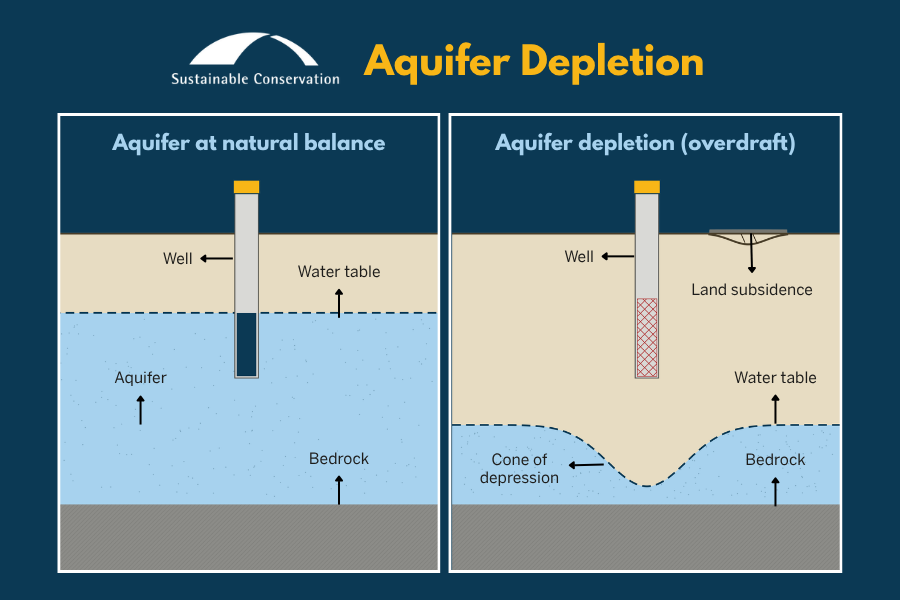
The problem starts when the withdrawals outpace the refill. Water managers call this “overdraft.” According to the U.S. Geological Survey, some aquifers take decades to recover from significant overdraft, and some never fully bounce back.
What causes the depletion of water in aquifers?
A few forces combine to drive aquifer depletion in California, and they often feed off each other.
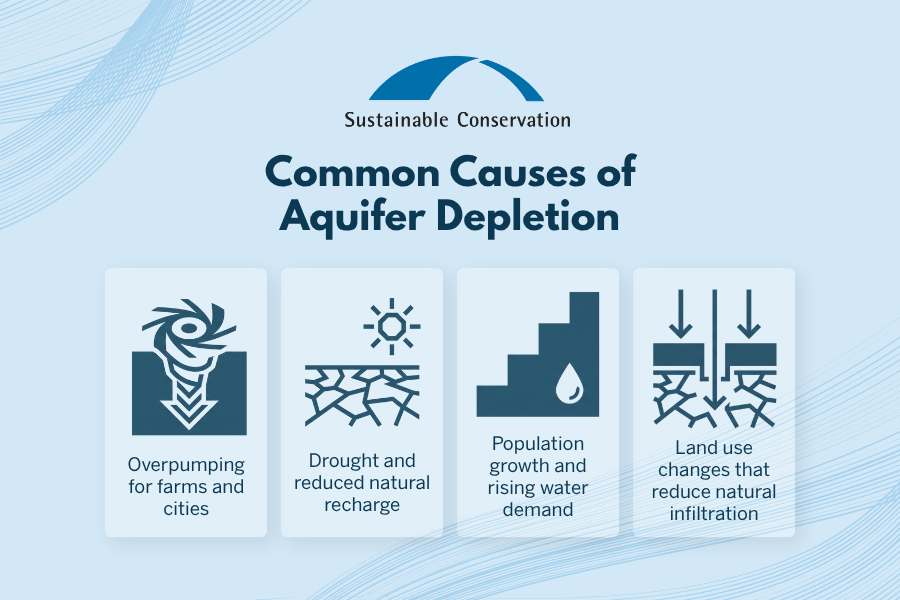
Overpumping for farms and cities
Groundwater supplies around 40% of the state’s water. Farms lean on it heavily when surface water from rivers and reservoirs runs short, and cities do, too. When pumping ramps up across a whole basin at once, the aquifer underneath can’t keep pace.
Drought and reduced natural recharge
Less rain and snowpack means less water soaking into the ground. And during drought, pumping usually increases at the exact same time recharge slows down. Research using NASA satellite data found that groundwater loss in the Central Valley has been accelerating since 2019, a period marked by some of the region’s driest years on record.
Population growth and rising water demand
More people means more water use across homes, businesses, and agriculture. Even without a drought, steady population growth adds pressure to groundwater basins over time.
Land use changes that reduce natural infiltration
Pavement, buildings, and compacted farmland can all block water from soaking into the ground the way it used to. Land that once absorbed rain and snowmelt now sheds it as runoff instead, so less water ever reaches the aquifer. Practices like cover cropping can help restore some of that natural infiltration on farmland.
What happens when aquifers run dry?
When an aquifer gets depleted, the effects show up both underground and on the surface.
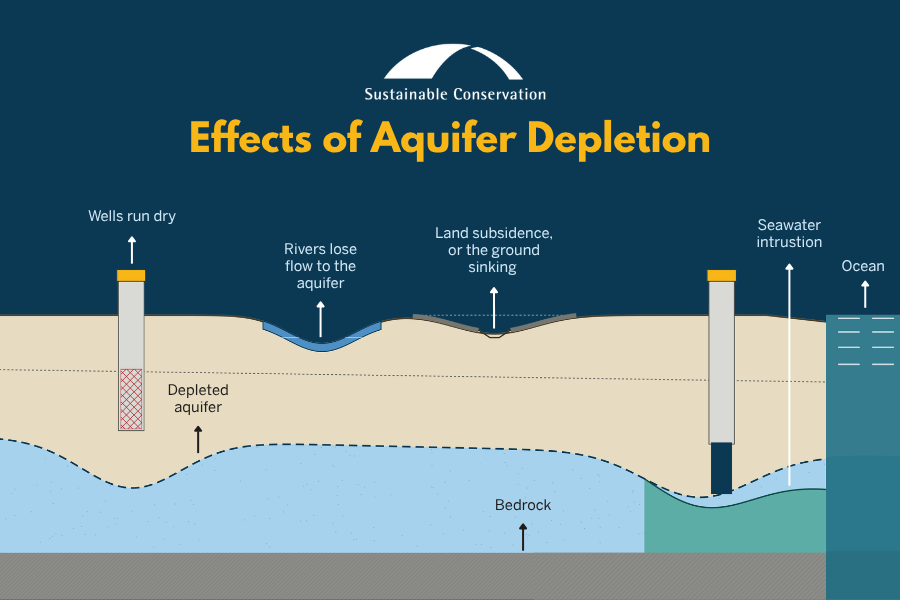
- Wells run dry. Shallower domestic wells are usually hit first, as they lose access to water that’s dropped further out of reach. In California, more than 2,000 household wells went dry over just the last few years of drought.
- Land sinks. Land above heavily drained aquifers can subside, cracking roads, damaging canals, and warping infrastructure that isn’t built to shift. In parts of the San Joaquin Valley, water tables have dropped nearly 5 feet a year, among the fastest rates of groundwater decline anywhere in the world.
- Seawater moves in. In coastal areas, depleted aquifers can pull in seawater, which contaminates the freshwater supply and can negatively affect nearby farmland.
- Rivers and streams lose flow. Where groundwater and surface water are connected, overdraft can shrink flow in nearby rivers and streams, which hurts fish and wildlife that depend on them, an impact that shapes some of our own riparian restoration work.
Healthier soil can ease some of this pressure. Our 2023 Soil-Water Report found that improving soil health helps more water infiltrate and stay in the ground before it’s ever pumped out.
How is California addressing aquifer depletion?
California passed the Sustainable Groundwater Management Act (SGMA) in 2014. It requires local water agencies to bring their basins into balance and stop long-term overdraft, with a deadline in the early 2040s for the most stressed basins. The state has identified 21 basins as critically overdrafted, meaning they face the earliest of those deadlines.
Hitting those targets won’t be easy everywhere. A 2026 study found that many wells in critically overdrafted Central Valley basins could still struggle to meet 2040 goals, even under aggressive pumping cuts, since aquifers take time to recover once they’ve been drawn down this far.
A few tools are helping agencies work toward those goals:
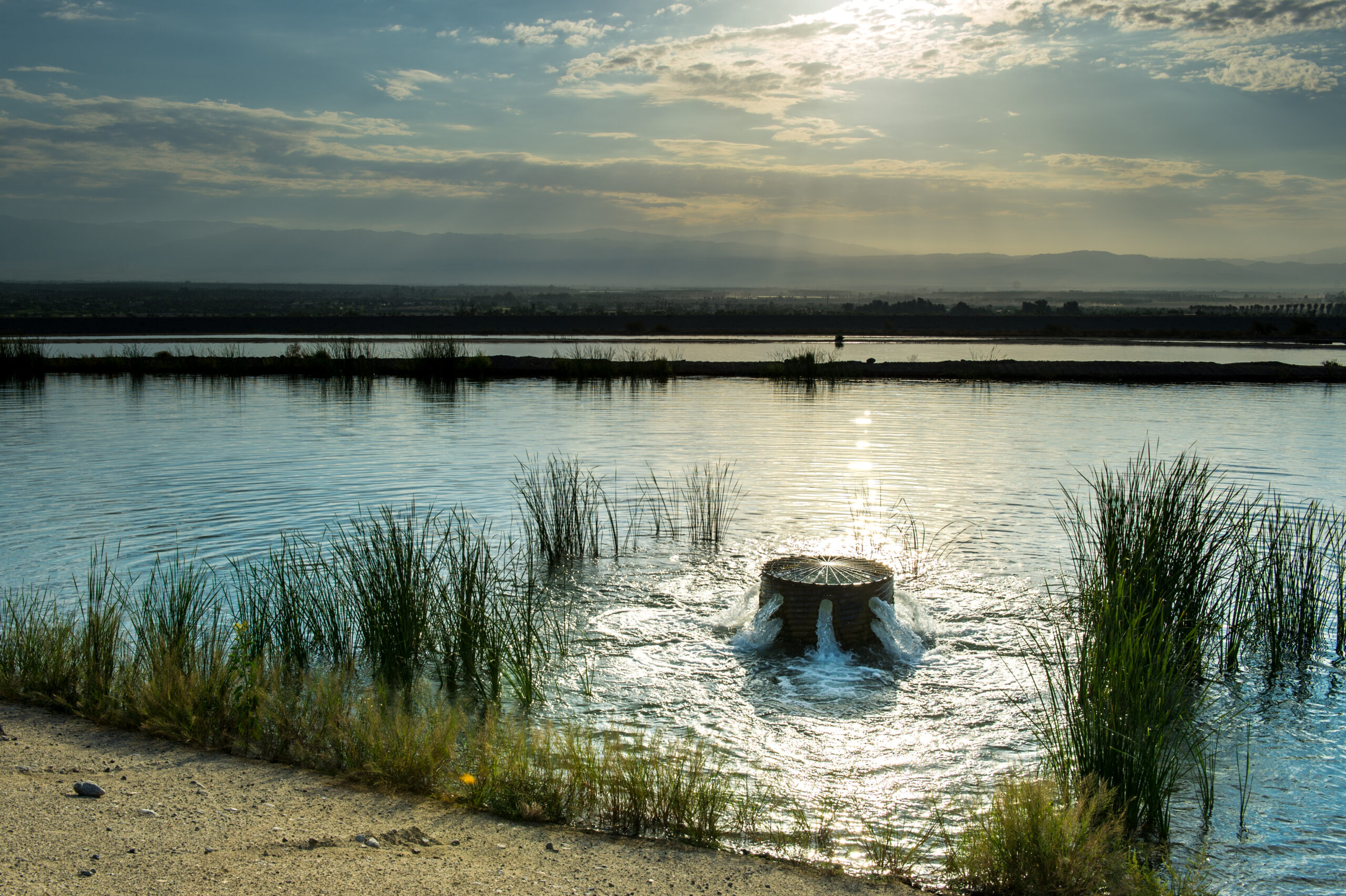
- Groundwater recharge: Groundwater recharge refers to capturing extra water, often floodwater or wet-year surplus, and moving it onto land where it can soak back into the aquifer. On farms, this sometimes means flooding fields or orchards in winter, when suitable crops are dormant and the land can absorb water without harming what’s growing.
- Coordinated planning by water districts and Groundwater Sustainability Agencies: Since recharge works best at scale, we’ve put together guidance for water districts on building coordinated recharge programs.
- Cover cropping: Our Cover Cropping in the SGMA Era report found that planting cover crops between growing seasons helps loosen soil and improve how well it takes in water, which supports recharge efforts happening at the same time.
What are common solutions for aquifer depletion?
Turning around decades of overdraft takes work at every level, from individual fields to entire water districts. Here’s what that looks like in practice.
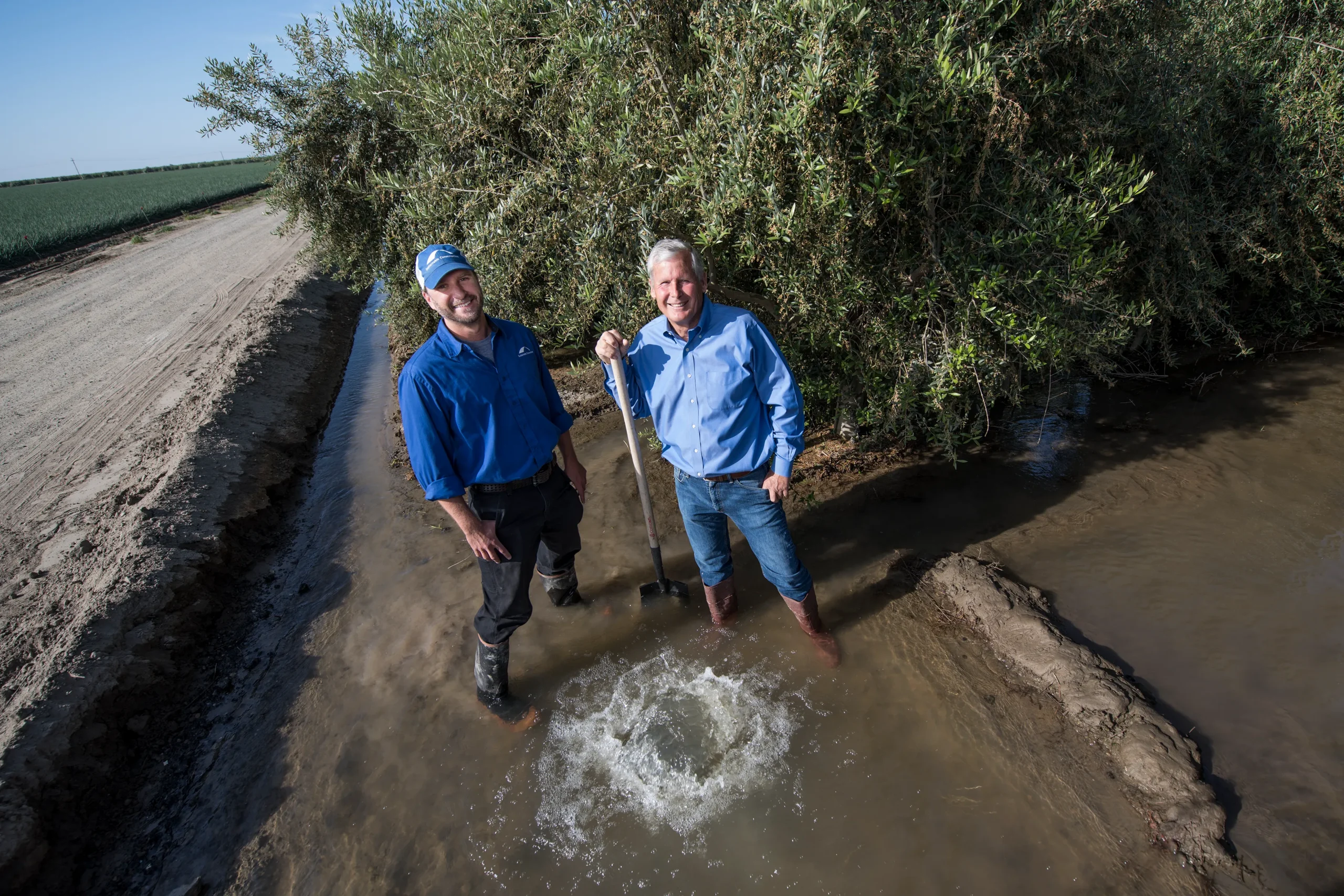
Turning around decades of overdraft takes work at every level, from individual fields to entire water districts. Here’s what that looks like in practice:
What can farmers do about aquifer depletion?
A few practices give farmers a direct way to put water back into the ground:
- On-farm groundwater recharge: Flooding fields or orchards with surplus water during wet periods, usually in winter when suitable crops are dormant and can handle the extra water without harm.
- Cover cropping: Improves how well soil takes in and holds water, so more of it soaks in rather than running off.
- Water-efficient irrigation: Drip and micro-irrigation systems cut down on water lost to evaporation and runoff, stretching existing groundwater further.
- Repurposing farmland: Shifting some acres out of irrigated production and into lower-water uses, like habitat, recharge basins, or dryland grazing, reduces how much a farm needs to pump.
None of these require a farm to overhaul everything at once. Many growers start with a single field or orchard block before scaling up. We keep resources for growers who want to explore recharge on their own land, and our soil health blog covers practical, farm-level updates on cover cropping and related work.
What can water managers and agencies do about aquifer depletion?
Local water agencies carry a lot of the responsibility for bringing basins back into balance under SGMA. That work includes:
- Identifying good sites for groundwater recharge
- Building infrastructure to move floodwater onto farmland or into recharge basins
- Designing incentive programs that make participation worthwhile for growers
- Coordinating across a whole basin, since groundwater doesn’t follow property lines
A recharge project on one farm can affect water levels for neighbors miles away, so coordination matters more than it might seem. That’s the piece we focus on through our Water for the Future program: bringing farmers and water managers to the same table so recharge efforts add up across a whole basin, instead of each project working in isolation.
What can communities do about aquifer depletion?
Community involvement can take a few different forms, depending on how much time someone has to give:
- Stay informed: Public meetings for Groundwater Sustainability Agencies are usually open to residents, and they’re a direct way to learn what’s proposed for a given basin before decisions get made.
- Support recharge infrastructure: This is especially important for projects that double as flood protection or add green space alongside their water benefits.
- Watch for projects near vulnerable wells: This matters most for communities near basins where domestic wells have already gone dry, since recharge sites near those wells can help stabilize the water table that households depend on.
We’ve put together resources for communities that want to understand how recharge projects can protect nearby drinking water wells.
Stay connected to California’s groundwater story
Recharge, cover cropping, and smarter water management are already turning things around in parts of California. If you want to stay in the loop on that work, or see what groundwater recharge looks like on the ground, here’s where to start.